A heartfelt collection of depression urdu shayari and moving depressed urdu quotes to help you find peace and expression amidst the silent struggles of the heart.
Finding the right words through depression poetry in urdu is often the first step toward understanding the heavy silence that settles within the soul. Human beings can have thoughts, emotions, and behaviors that are worth contemplating and expressing because of the profound impression they leave on our mental well-being. Furthermore, acknowledging the reality of sadness as it is lived is necessary to eventually achieve some reflection; this includes a realistic and enlightening view that leads to a path of healing and eventual happiness.
Every day can be a valid reason to seek comfort in words and strive to be someone who understands the weight of the years they have lived, finding strength in every step of the journey. In this article, we have selected the most moving depression urdu shayari and emotional depression quotes in urdu for you to use when you need to express the feelings that words alone cannot capture in your daily life.
The day-to-day can be filled with difficult moments that teach us lessons that last a lifetime, and having access to depressed urdu quotes helps in processing these complex feelings. To accomplish this, it is necessary to have valuable depression poetry in urdu (ڈپریشن شاعری) that gives a voice to these hidden thoughts. Thus, we have provided some deeply relatable verses and quotes from everyday life that will resonate with your heart.
Table of Contents
Depression Quotes in Urdu (Deep Thoughts)
Sometimes, a single line of prose can explain a world of pain better than a thousand conversations. These depression quotes in urdu are curated for those seeking a realistic and enlightening view of mental struggles, providing a mirror to the soul. Whether you are looking for depressed urdu quotes to validate your feelings or to share with someone who understands, these lines offer a profound sense of connection.
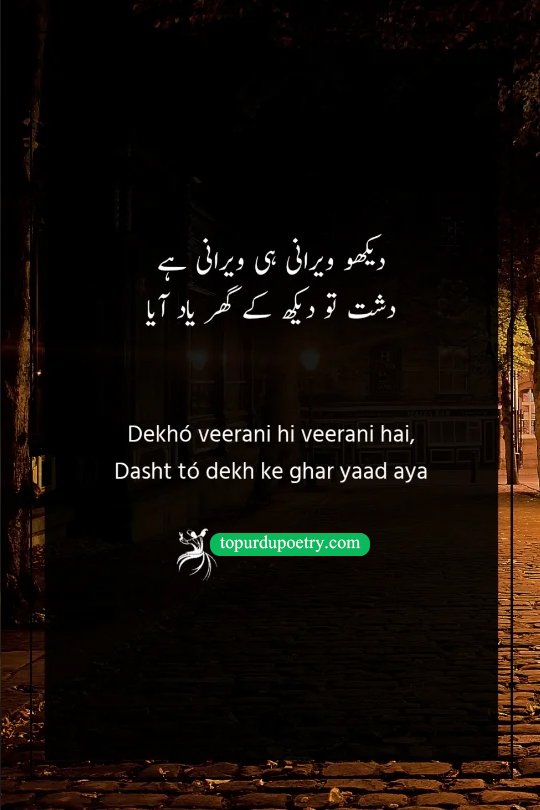
دیکھو ویرانی ہی ویرانی ہے دشت تو دیکھ کے گھر یاد آیا
Dekhó veerani hi veerani hai, Dasht tó dekh ke ghar yaad aya
This profound couplet captures the peak of emotional isolation. The poet observes a vast 'Dasht' (wilderness) and, instead of feeling out of place, he is reminded of his own home. It suggests a tragic reality where one's personal life or household has become so empty and desolate ('veerani') that it resembles a barren desert.
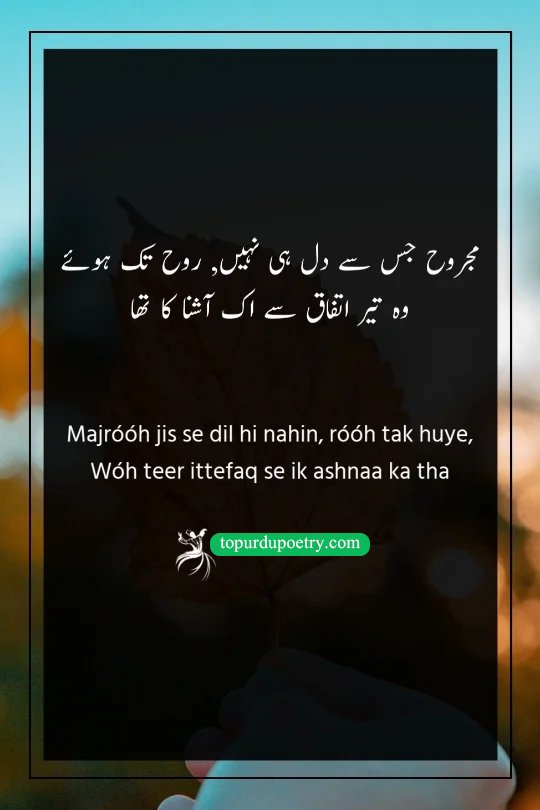
مجروح جس سے دل ہی نہیں, روح تک ہوئے وہ تیر اتفاق سے اک آشنا کا تھا
Majróóh jis se dil hi nahin, róóh tak huye, Wóh teer ittefaq se ik ashnaa ka tha
This hard-hitting couplet explores the devastating impact of betrayal by someone close. The poet describes a wound so deep that it reaches beyond the heart to scar the 'Rooh' (soul). The tragedy lies in the source of the injury: it wasn't an enemy's attack, but an arrow (teer) from an 'Ashnaa' (a friend or acquaintance). It perfectly captures the sentiment that trust makes us vulnerable, and the closer the person, the deeper the wound.
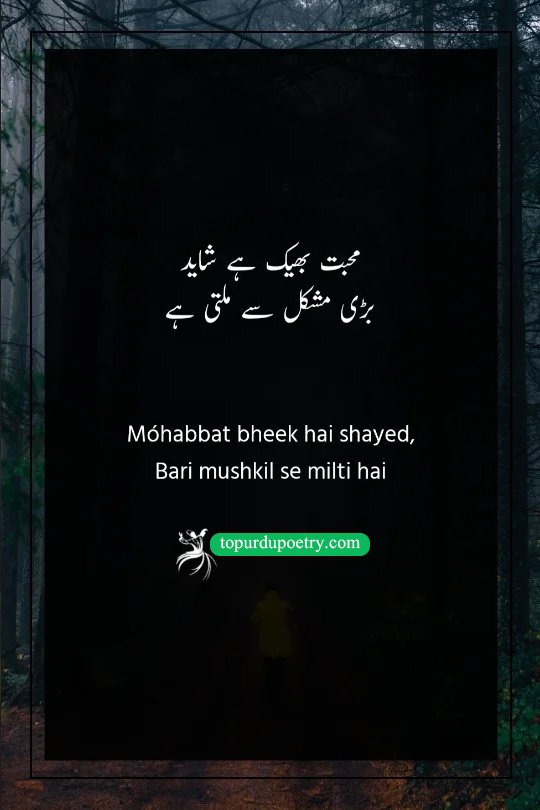
Móhabbat bheek hai shayed, Bari mushkil se milti hai
This soul-stirring couplet compares the pursuit of love to the act of begging. By using the word 'Bheek' (alms), the poet illustrates the extreme vulnerability and the loss of ego that often comes with deep affection. It suggests that genuine 'Mohabbat' is not easily found; it is a rare blessing that one often has to plead for, and even then, it is 'Bari mushkil' (very difficult) to obtain.
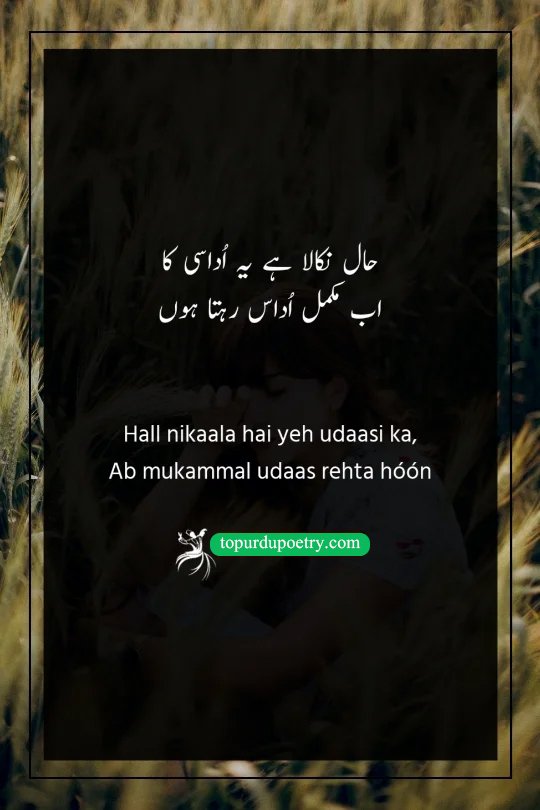
Hall nikaala hai yeh udaasi ka, Ab mukammal udaas rehta hóón
This chilling couplet captures the essence of deep-seated depression. The poet speaks of finding a 'solution' to his recurring sadness, which is to stop fighting it altogether and remain 'mukammal udaas' (completely sad). It reflects the stage of grief where a person becomes so tired of the emotional roller coaster that they accept darkness as their permanent reality.
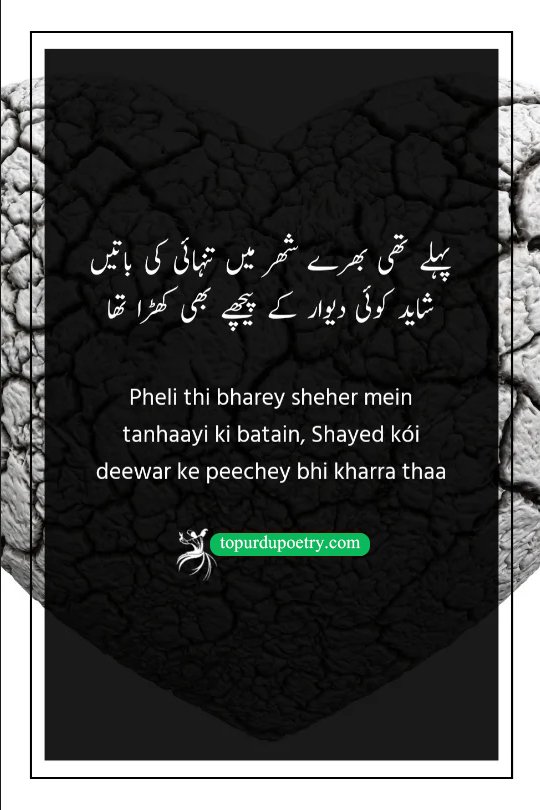
پہلے تھی بھرے شھر میں تنہائی کی باتیں شاید کوئی دیوار کے پیچھے بھی کھڑا تھا
Pheli thi bharey sheher mein tanhaayi ki batain, Shayed kói deewar ke peechey bhi kharra thaa
This intriguing couplet delves into the intersection of private loneliness and public scrutiny. The poet reflects on how his 'tanhaayi' (loneliness) became a topic of conversation across the entire city, leading to the haunting realization that he might not have been as alone as he thought. It captures the feeling of being watched by the 'walls' of society even in one's most solitary moments.
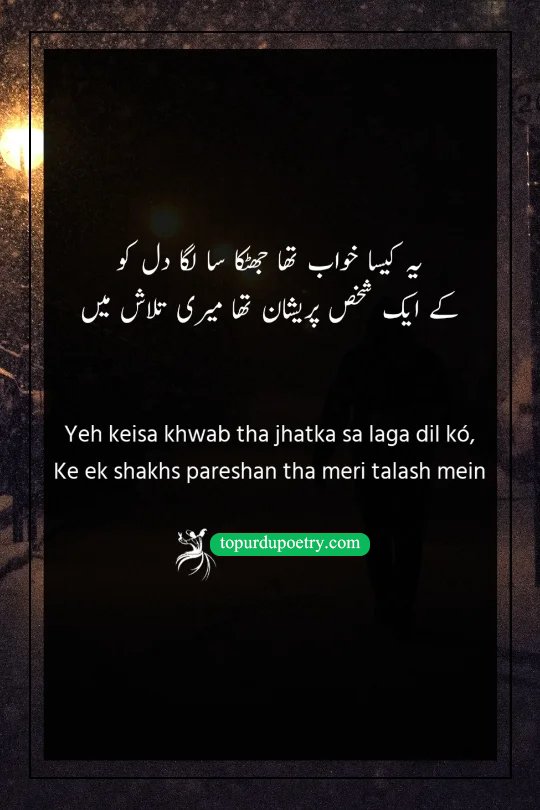
یہ کیسا خواب تھا جھٹکا سا لگا دل کو کے ایک شخص پریشان تھا میری تلاش میں
Yeh keisa khwab tha jhatka sa laga dil kó, Ke ek shakhs pareshan tha meri talash mein
This evocative couplet explores the powerful emotions of the subconscious. The poet describes a dream that leaves the heart in a state of shock ('jhatka'). The cause of this agitation is the sight of someone searching for the poet with great distress ('pareshan'). it beautifully captures the hidden desire to be missed, wanted, and sought after by another.
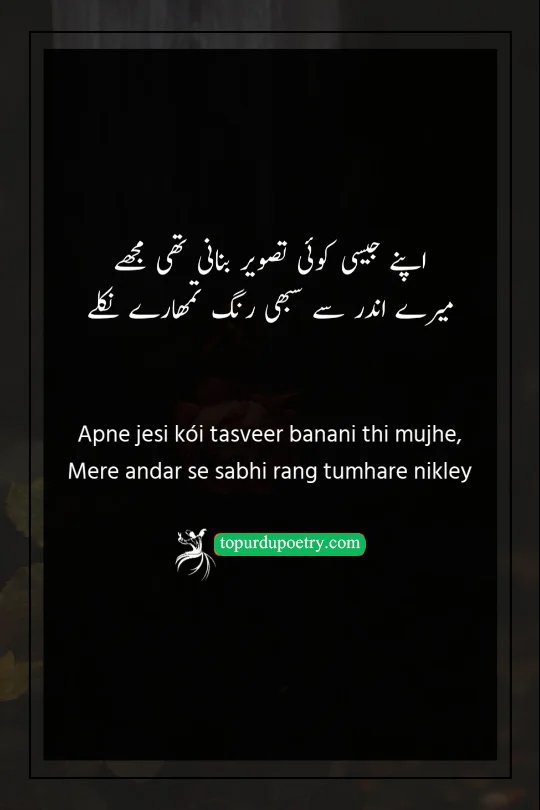
اپنے جیسی کوئی تصویر بنانی تھی مجھے میرے اندر سے سبھی رنگ تمھارے نکلے
Apne jesi kói tasveer banani thi mujhe, Mere andar se sabhi rang tumhare nikley
This exquisite couplet explores the concept of 'Fanaa'—the merging of one's identity into another. The poet describes an attempt to create a self-portrait or find his own essence, only to discover that every 'color' of his soul now belongs to the beloved. It captures the profound impact of love, where the lines between 'self' and 'other' vanish entirely.
Best Depression Poetry in Urdu (ڈپریشن شاعری)
Sometimes, finding the right words to describe a heavy heart is the first step toward feeling understood. Exploring depression poetry in urdu allows you to connect with the deep emotions that are often hard to explain in daily conversation. In this collection, we have gathered the most moving depression urdu shayari and heartfelt lines to help you express the silence within.
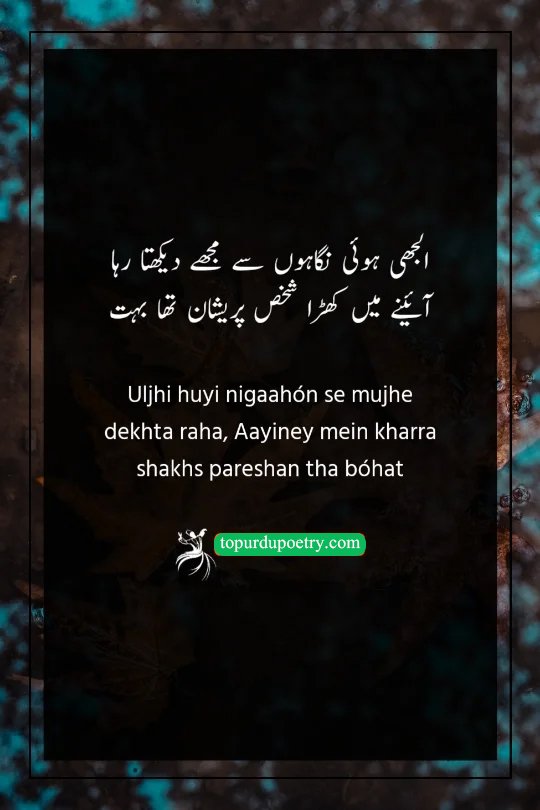
This deeply psychological couplet explores the theme of self-identity and internal struggle. The poet describes a moment of looking into a mirror and seeing a 'stranger' staring back with tangled, confused eyes. It captures the heartbreaking reality of being so overwhelmed by life's troubles that you no longer recognize your own face.
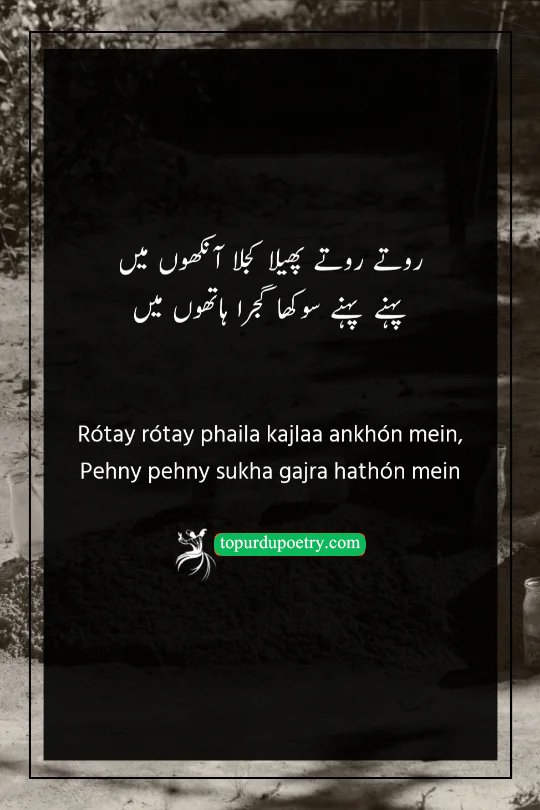
This striking couplet uses two powerful visual symbols—smudged kohl and dried flowers—to portray a state of deep emotional neglect. The 'phaila kajla' (smudged kohl) represents a face marked by endless tears, while the 'sukha gajra' (dried flower-bracelet) symbolizes a celebration that never happened or a wait that lasted too long. It is a profound poetry reflecting a soul that has stopped caring for itself while trapped in grief.
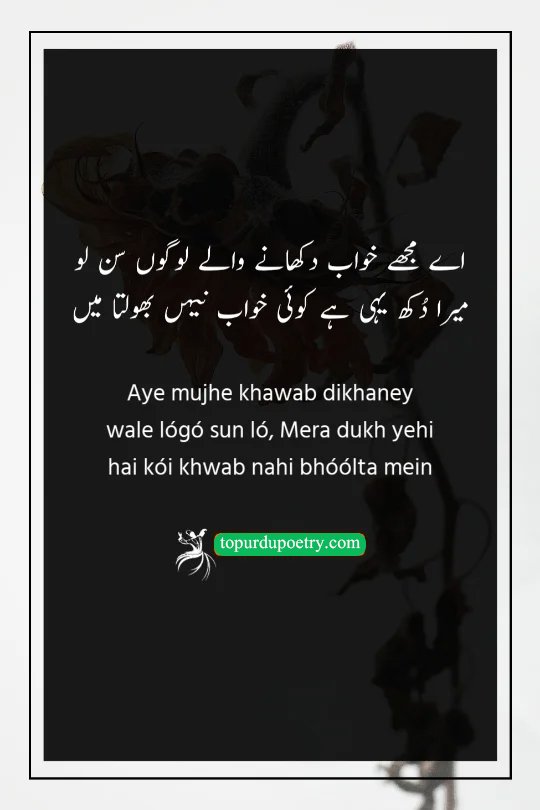
اے مجھے خواب دکھانے والے لوگوں سن لو میرا دُکھ یہی ہے کوئی خواب نیہں بھولتا میں
Aye mujhe khawab dikhaney wale lógó sun ló, Mera dukh yehi hai kói khwab nahi bhóólta mein
This striking couplet explores the burden of a long memory and unfulfilled hopes. The poet addresses those who offer dreams and promises, revealing his greatest struggle: the inability to forget. While the world moves on, the poet remains anchored to every 'khwab' (dream) he was ever shown. It is a profound reflection on the persistence of pain and the heavy weight of remembering what one has lost.
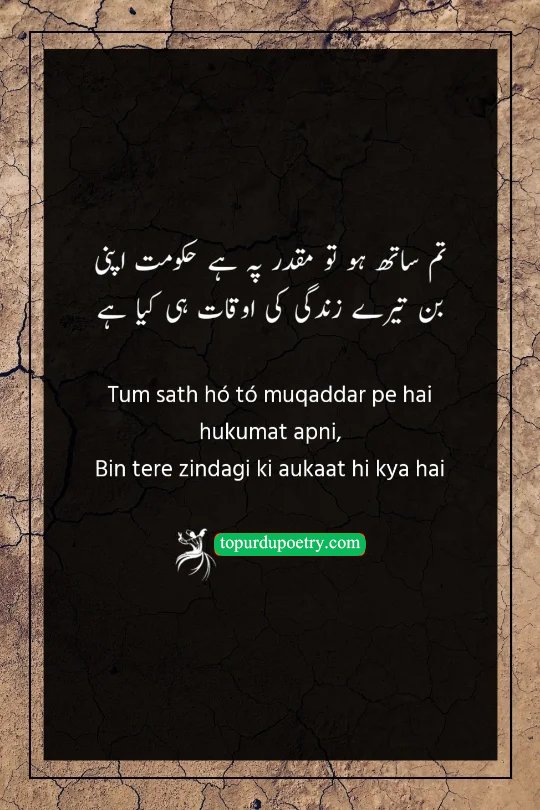
تم ساتھ ہو تو مقدر پہ ہے حکومت اپنی بن تیرے زندگی کی اوقات ہی کیا ہے
Tum sath hó tó muqaddar pe hai hukumat apni, Bin tere zindagi ki aukaat hi kya hai
This soul-stirring couplet expresses the peak of romantic devotion. The poet describes his beloved's presence as a source of ultimate power, giving him 'hukumat' (control) over his own destiny. In contrast, it portrays life without them as having no 'aukaat' (worth or status). It is a beautiful representation of how one person can become the entire center of someone's universe.
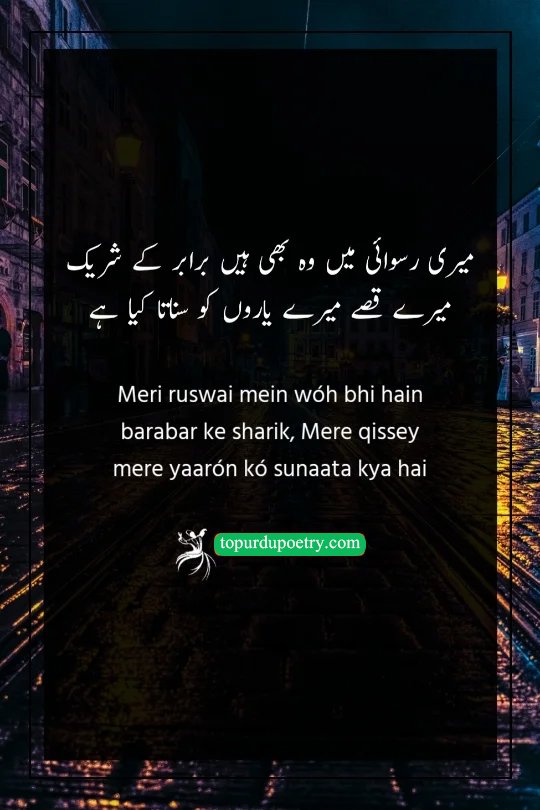
میری رسوائی میں وہ بھی ہیں برابر کے شریک میرے قصے میرے یاروں کو سناتا کیا ہے
Meri ruswai mein wóh bhi hain barabar ke sharik, Mere qissey mere yaarón kó sunaata kya hai
This hard-hitting couplet exposes the hypocrisy of those who betray our trust. The poet reminds his accuser that they are 'barabar ke sharik' (equal partners) in whatever 'ruswai' (disgrace) they are now gossiping about. It specifically points out the pain of an insider taking one's private 'qissey' (stories) to their 'yaaron' (friends) to tarnish their image.
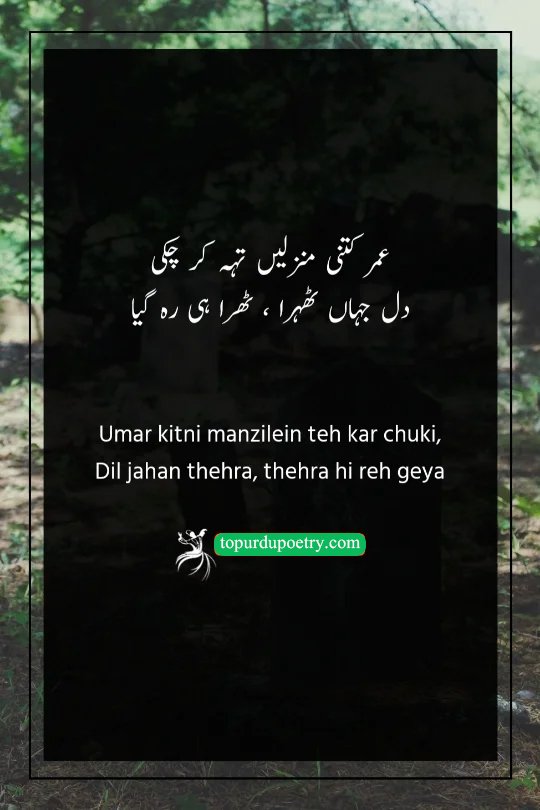
عمر کتنی منزلیں تہہ کر چکی دل جہاں ٹھہرا ، ٹھرا ہی رہ گیا
Umar kitni manzilein teh kar chuki, Dil jahan thehra, thehra hi reh geya
This deeply philosophical couplet explores the disconnect between physical aging and emotional healing. While 'Umar' (life/age) continues to cross milestones and move forward, the 'Dil' (heart) remains frozen in a single moment of the past. It perfectly describes the experience of being unable to move on from a specific memory or heartbreak, even as the years go by.
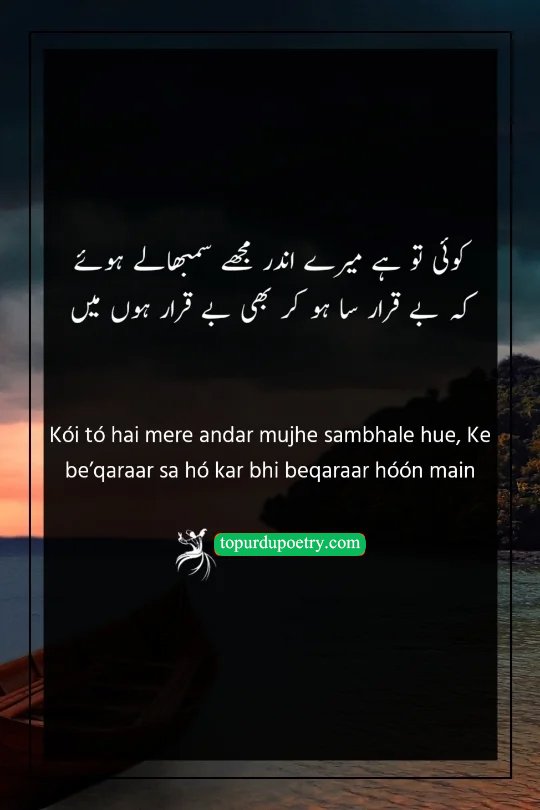
کوئی تو ہے میرے اندر مجھے سمبھالے ہوئے کہ بے قرار سا ہو کر بھی باقرار ہوں میں
Kói tó hai mere andar mujhe sambhale hue, Ke be’qaraar sa hó kar bhi ba-qarar hóón main
This deep and comforting couplet explores the hidden strength within a person facing mental or emotional turmoil. It describes the sensation of being 'be-qaraar' (restless) on the surface, yet being held together by an unknown inner force that keeps one 'ba-qarar' (steady). It is a powerful reminder that even in our darkest moments of depression, there is a part of us that refuses to let go.
Depression Urdu Shayari (Emotional 2-Line Verses)
This section features the best depression urdu shayari for those who prefer the rhythmic beauty of traditional poetry. These 2-line couplets are perfect for capturing the essence of sadness and the reality of a tired soul.
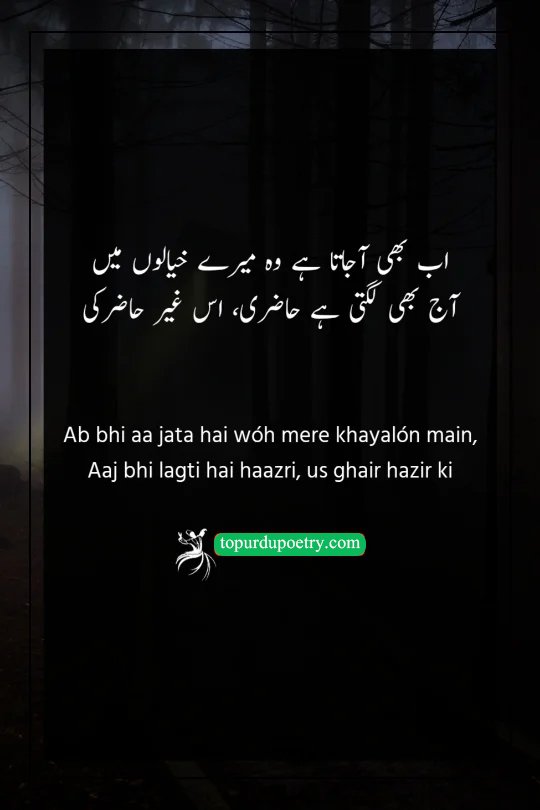
اب بھی آجاتا ہے وہ میرے خیالوں میں آج بھی لگتی ہے حاضری، اس غیر حاضرکی
Ab bhi aa jata hai wóh mere khayalón main, Aaj bhi lagti hai haazri, us ghair hazir ki
This clever and emotional couplet uses the metaphor of 'attendance' to describe the lingering presence of a lost loved one. The poet highlights the irony of a person who is physically gone ('ghair hazir') yet remains mentally ever-present ('haazri'). It perfectly captures the feeling of being haunted by memories that refuse to fade away.
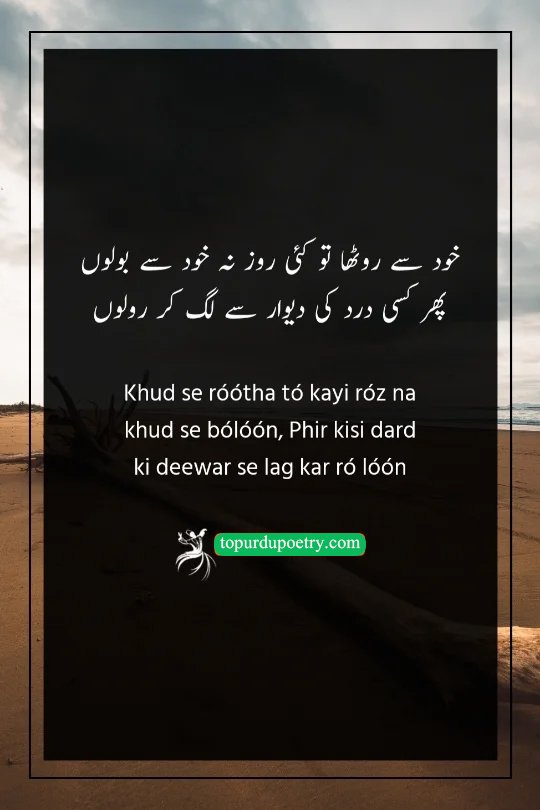
خود سے روٹھا تو کئی روز نہ خود سے بولوں پھر کسی درد کی دیوار سے لگ کر رولوں
Khud se róótha tó kayi róz na khud se bólóón, Phir kisi dard ki deewar se lag kar ró lóón
This deeply emotional couplet explores the theme of self-conflict and internal isolation. The poet describes a state where he is so frustrated with himself that he stops all internal dialogue, entering a period of self-imposed silence. Eventually, this isolation leads to a breakdown where 'Dard' (pain) becomes the only thing he can lean on.
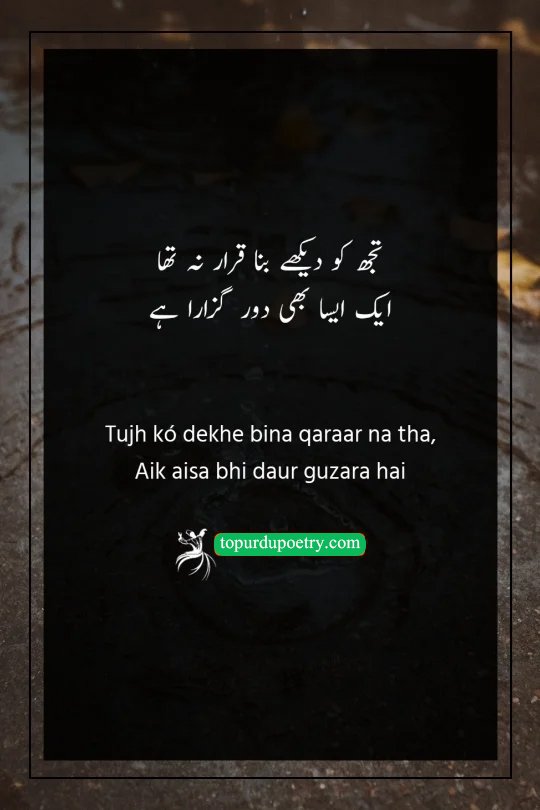
تجھ کو دیکھے بنا قرار نہ تھا ایک ایسا بھی دور گزارا ہے
Tujh kó dekhe bina qaraar na tha, Aik aisa bhi daur guzara hai
This classic couplet reflects on the passage of time and the changing nature of the heart. The poet looks back at a 'daur' (era) when his peace was entirely dependent on the sight of his beloved. Now, that time has passed, leaving behind a bittersweet realization of how one can survive even after losing what they once thought was essential for life.
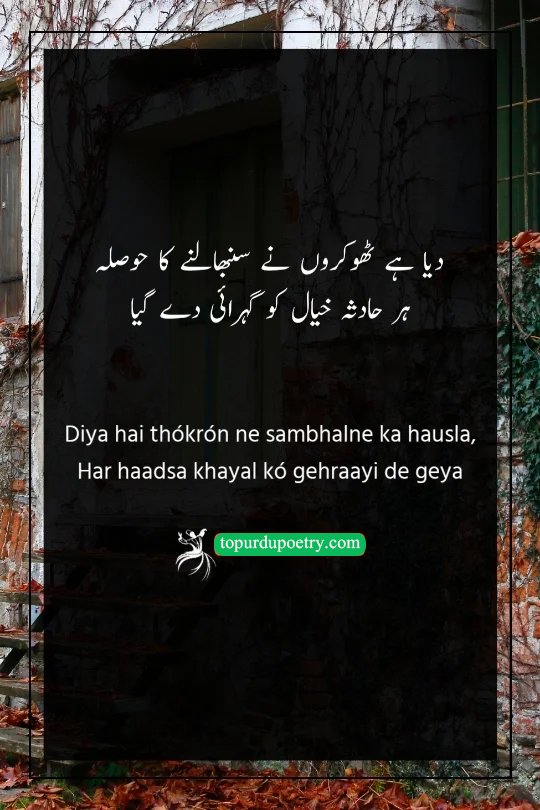
دیا ہے ٹھوکروں نے سنبھالنے کا حوصلہ ہر حادثہ خیال کو گہرائی دے گیا
Diya hai thókrón ne sambhalne ka hausla, Har haadsa khayal kó gehraayi de geya
This empowering couplet redefines the meaning of hardship. Instead of viewing failures and tragedies as mere losses, the poet sees them as tools for growth. The 'thokar' (stumbling) provides the 'hausla' (courage) to be resilient, and every 'haadsa' (tragedy) adds a layer of 'gehraayi' (depth) to one's wisdom.
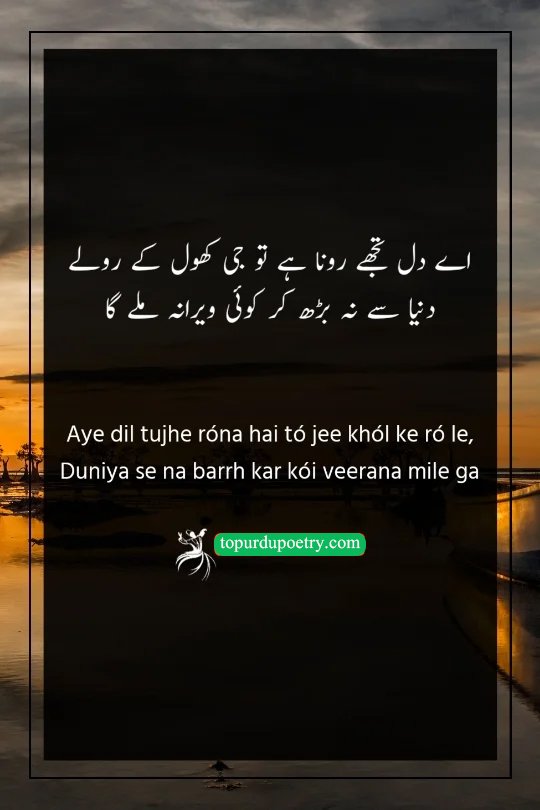
اے دل تجھے رونا ہے تو جی کھول کے رولے دنیا سے نہ بڑھ کر کوئی ویرانہ ملے گا
Aye dil tujhe róna hai tó jee khól ke ró le, Duniya se na barrh kar kói veerana mile ga
This profound couplet explores the loneliness one feels even when surrounded by the world. The poet encourages the heart to cry freely ('jee khol ke'), arguing that there is no need to seek a deserted place for grief. He claims that the 'Duniya' (world) itself is the ultimate 'Veerana' (wilderness)—a place so empty of true connection that it is the best backdrop for a broken heart.
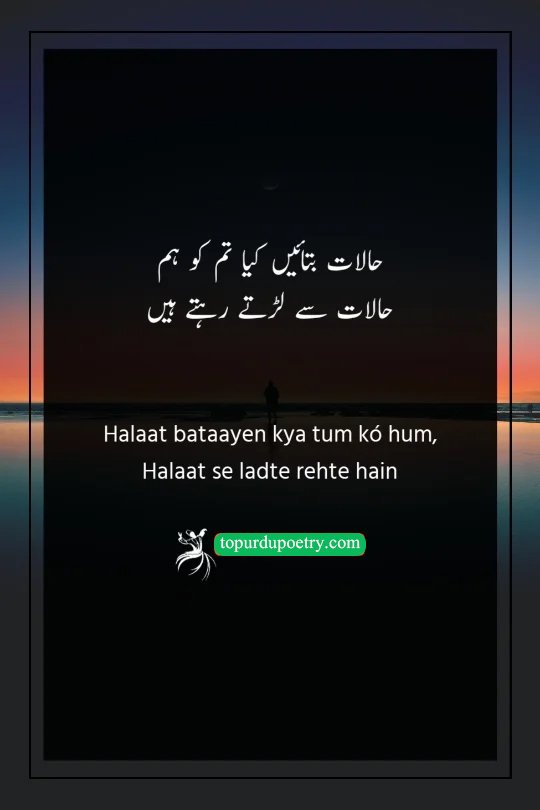
Halaat bataayen kya tum kó hum, Halaat se ladte rehte hain
This powerful couplet captures the essence of resilience. Instead of detailing the hardships of life, the poet simply states that they are in a constant battle with their 'Halaat' (circumstances). It resonates deeply with anyone who feels that life is a continuous struggle but refuses to give up.
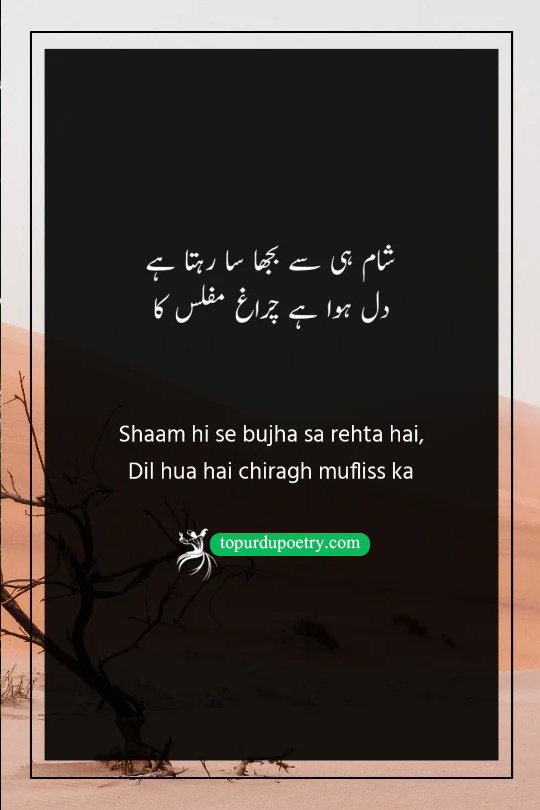
Shaam hi se bujha sa rehta hai, Dil hua hai chiragh mufliss ka
This profound couplet uses the metaphor of a 'chiragh-e-muflis' (a poor man's lamp) to describe the emotional depletion of depression. Just as a lamp without oil cannot stay lit, a heart drained by constant sorrow stays 'bujha sa' (dim/extinguished) even as the evening begins. It perfectly captures the feeling of having no inner strength left to face the darkness of loneliness.
Depressed Urdu Quotes for WhatsApp & Social Media
If you are looking for impactful depressed urdu quotes to update your status or share with a close friend, these lines are specifically chosen for their relatability. These depression quotes in urdu deliver a punch of emotion in just a few words.
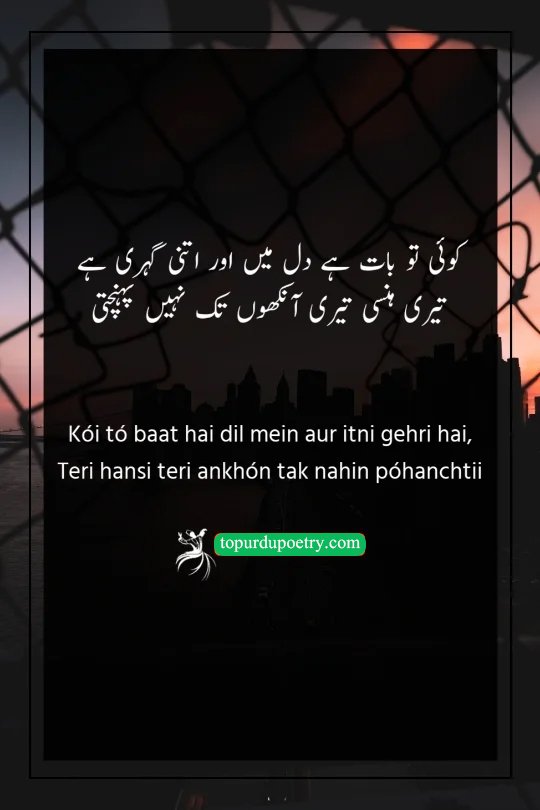
کوئی تو بات ہے دل میں اور اتنی گہری ہے تیری ہنسی تیری آنکھوں تک نہیں پہنچتی
Kói tó baat hai dil mein aur itni gehri hai, Teri hansi teri ankhón tak nahin póhanchtii
This hauntingly accurate couplet captures the essence of 'functional sadness.' It describes the moment someone notices that your smile is just a mask because the joy never reaches your eyes. It reflects a pain so 'gehri' (deep) that even the loudest laughter cannot hide it.
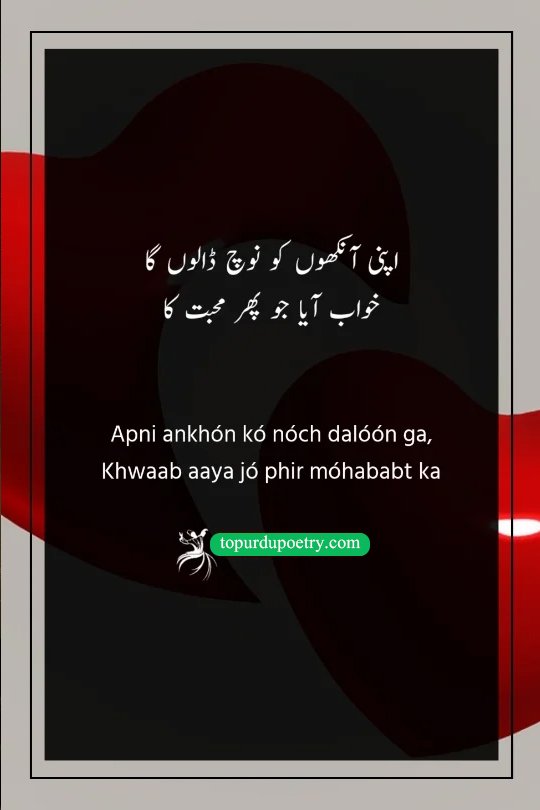
اپنی آنکھوں کو نوچ ڈالوں گا خواب آیا جو پھر محبت کا
Apni ankhón kó nóch dalóón ga, Khwaab aaya jó phir móhababt ka
This intense and aggressive couplet captures the ultimate rejection of love. The poet expresses a level of trauma where even the 'dream' of love feels like a threat. By claiming he would 'noch dalun' (gouge out) his eyes, he illustrates a desperate need to protect himself from being fooled by hope again.
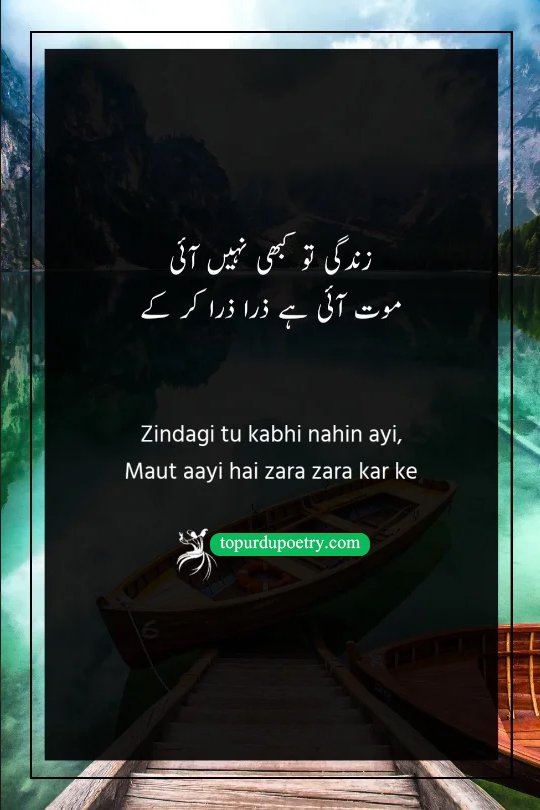
Zindagi tu kabhi nahin ayi, Maut aayi hai zara zara kar ke
This haunting couplet redefines the relationship between life and death. The poet laments that a true, vibrant 'Zindagi' (Life) never reached him, while 'Maut' (Death) did not come as a final event but as a slow, agonizing process. It captures the essence of a soul being worn away by the struggles of existence 'zara zara' (bit by bit).
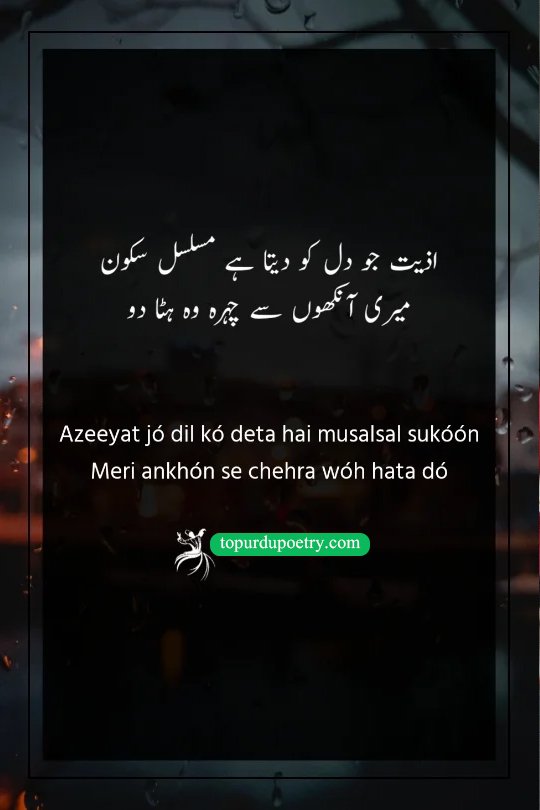
اذیت جو دل کو دیتا ہے مسلسل سکون میری آنکھوں سے چہرہ وہ ہٹا دو
Azeeyat jó dil kó deta hai musalsal sukóón Meri ankhón se chehra wóh hata dó
This striking couplet explores the 'addiction to agony' that often follows a broken heart. The poet describes a state where 'Azeeyat' (torment) has become so constant that it feels like 'Sukoon' (peace)—a dangerous comfort found in deep sadness. The second line is a desperate plea to remove the haunting image of the beloved, as it is the source of this toxic cycle.
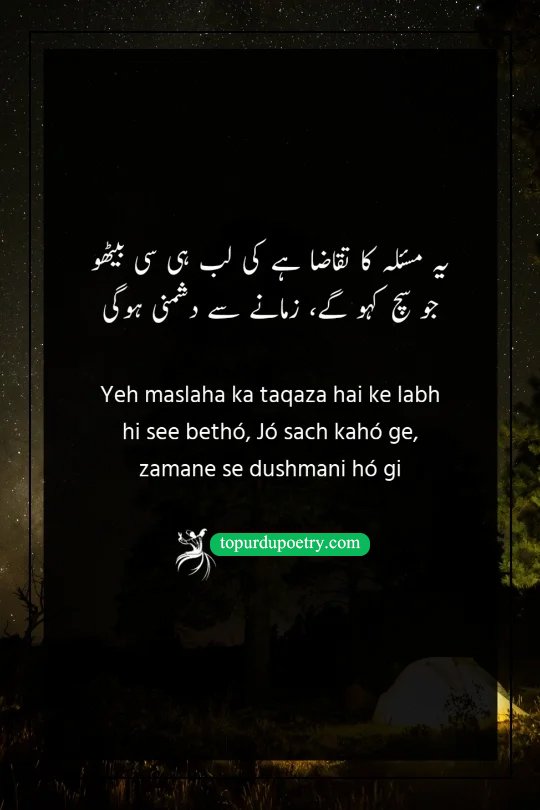
یہ مصلحت کا تقاضا ہے کہ لب ہی سی بیٹھو جو سچ کہو گے، زمانے سے دشمنی ہوگی
Yeh maslahat ka taqaza hai ke labh hi see bethó, Jó sach kahó ge, zamane se dushmani hó gi
This realistic couplet explores the price of truth in a hypocritical society. The poet argues that 'Maslahat' (prudence or self-interest) requires one to stay silent ('labh see betho'). He warns that honesty comes at a high cost, as speaking the truth inevitably leads to 'dushmani' (enmity) with the world.
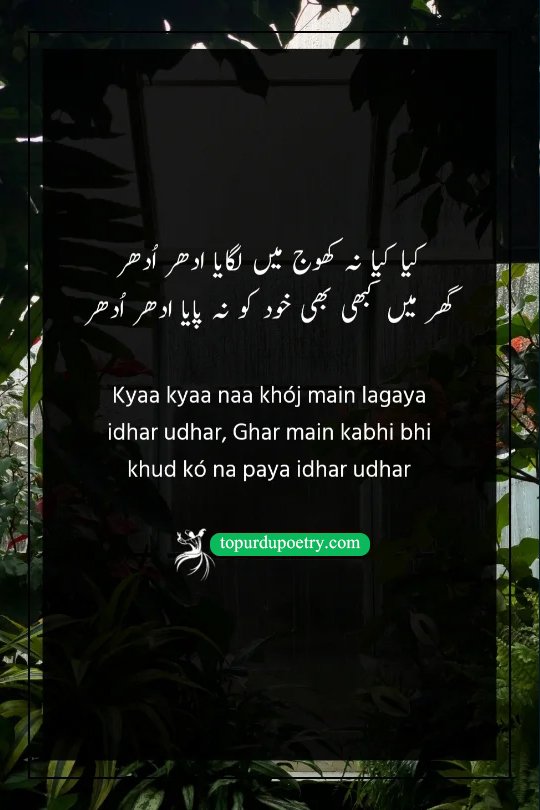
کیا کیا نہ کھوج میں لگایا ادھر اُدھر گھر میں کبھی بھی خود کو نہ پایا ادھر اُدھر
Kyaa kyaa naa khój main lagaya idhar udhar, Ghar main kabhi bhi khud kó na paya idhar udhar
This philosophical couplet explores the concept of self-discovery and the internal void. The poet reflects on a life spent searching for meaning in the external world ('idhar udhar'), only to realize that he remains a stranger to his own soul ('Ghar'). It is a powerful reminder that true peace and identity cannot be found outside until one is 'at home' with themselves.
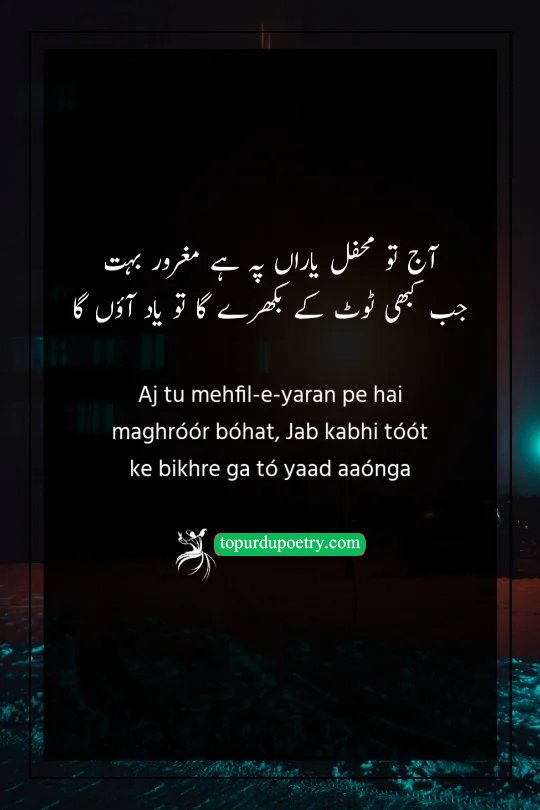
آج تو محفل یاراں پہ ہے مغرور بہت جب کبھی ٹوٹ کے بکھرے گا تو یاد آؤں گا
Aj tu mehfil-e-yaran pe hai maghróór bóhat, Jab kabhi tóót ke bikhre ga tó yaad aaónga
This sharp and soulful couplet captures the reality of superficial relationships and the value of true loyalty. The poet addresses someone currently blinded by the 'Mehfil' (gathering) of friends, predicting that their pride will only last as long as their good times. It is a powerful reminder that we only realize who truly cared for us once we are 'Toot ke bikhre' (broken and scattered).
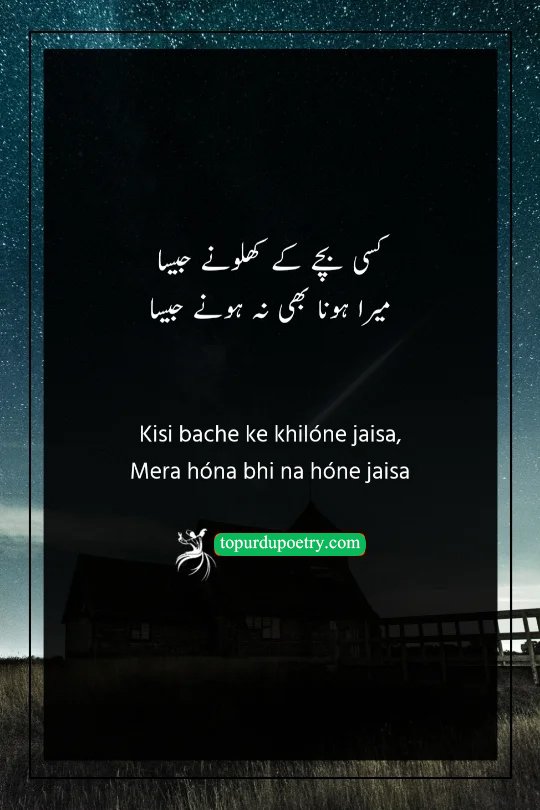
Kisi bache ke khilóne jaisa, Mera hóna bhi na hóne jaisa
This haunting couplet uses the imagery of a discarded toy to describe the crushing weight of feeling insignificant. The poet compares their existence to something that is easily used and just as easily forgotten, eventually concluding that their presence in this world feels no different from being absent. It is a raw and honest portrayal of the 'existential void' often felt in deep depression.
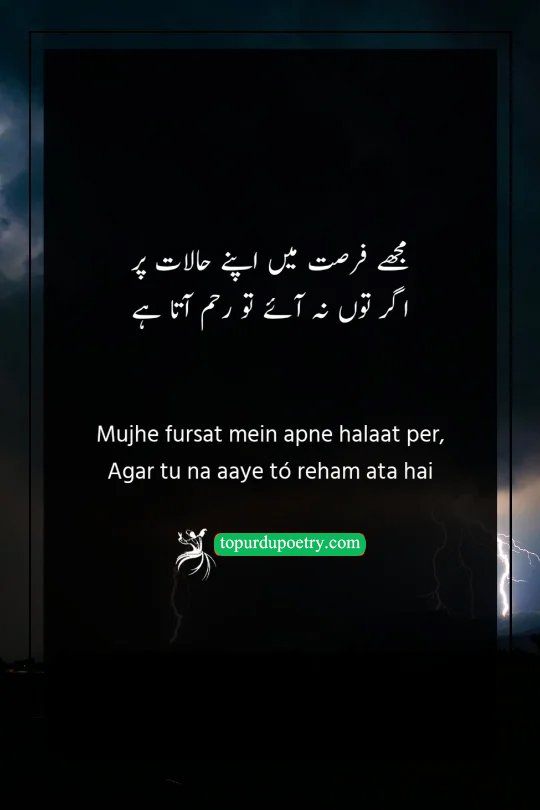
مجھے فرصت میں اپنے حالات پر اگر توں نہ آئے تو رحم آتا ہے
Mujhe fursat mein apne halaat per, Agar tu na aaye tó reham ata hai
This deeply moving couplet captures the moment of self-realization that follows a consuming love. The poet admits that as long as the beloved is present, he is distracted from his own pain. However, in 'fursat' (leisure) and absence, he finally sees the state of his own life and feels a profound sense of 'reham' (pity) for himself.
Final Thoughts on Finding Words
Sharing your struggle through depression urdu shayari or depressed urdu quotes can be a therapeutic way to process difficult days. We hope this collection provided the exact words your heart was searching for.
Which of these depression quotes in urdu felt the most relatable to you? Do you have a favorite 2-line verse that helps you cope?
Share your thoughts in the comments below! Don’t forget to download our custom images for your statuses. For more deep reflection, check out our guide on Poetry About Life in Urdu (Zindagi Shayari).