The first drop of rain touching the dry earth brings a wave of emotions that ordinary words often fail to capture. In the rich tradition of Urdu literature, barish poetry in Urdu is celebrated for its ability to reflect the deepest corners of the human heart. Whether the rain brings a sense of refreshing joy, a longing for a beloved, or a wave of bittersweet nostalgia, these verses capture the magic of the changing sky.
Interestingly, environmental psychologists studying how weather impacts our mood note that the rhythmic, soothing sound of falling rain naturally lowers our stress levels and triggers deep internal reflection. This scientific connection explains why we instinctively turn to poetry when the skies open up. By reading and sharing these couplets, you can perfectly articulate the magic and melancholy that a rainy day brings.
If the rain reminds you of a special someone you are longing to see, you might also find comfort in our heartfelt collection of Yaad (Missing You) Poetry in Urdu.
Table of Contents
The Symphony of the Soul: Deep Barish Poetry
Beyond the romance and the heartbreak, rain possesses a quiet, almost spiritual quality that speaks directly to our inner selves. Our collection of soulful barish poetry in Urdu text delves into this profound connection, portraying the falling rain as a gentle melody that washes away the exhaustion of everyday life. These deeply introspective verses explore how a quiet, rainy night can bring absolute peace, allowing us to sit with our thoughts and connect with our most authentic feelings. For those who find comfort in the soft patter of raindrops against a windowpane, these barish quotes (بارش پوئٹری) beautifully articulate the silent conversations we have with our own souls when the world outside goes still.
سنا ہے بارش اُسے بھی پسند ہے وہ بھی میری طرح برستی بوندوں کو ہاتھوں میں سما لیتی ہے
Suna hai barish usay bhi pasand hai, Wó bhi meri tarha barasti bundón kó hathón may sama leti hay
This soft and romantic barish poetry in Urdu beautifully captures the feeling of being connected to a loved one through nature, despite the distance. The poet finds comfort in the shared habit of catching raindrops, highlighting a deep, innocent harmony between their souls. Rain ('Barish') has always been a symbol of longing and romance in literature. It perfectly captures the quiet joy of knowing that the person you miss is standing under the same rainy sky, sharing the exact same feeling.
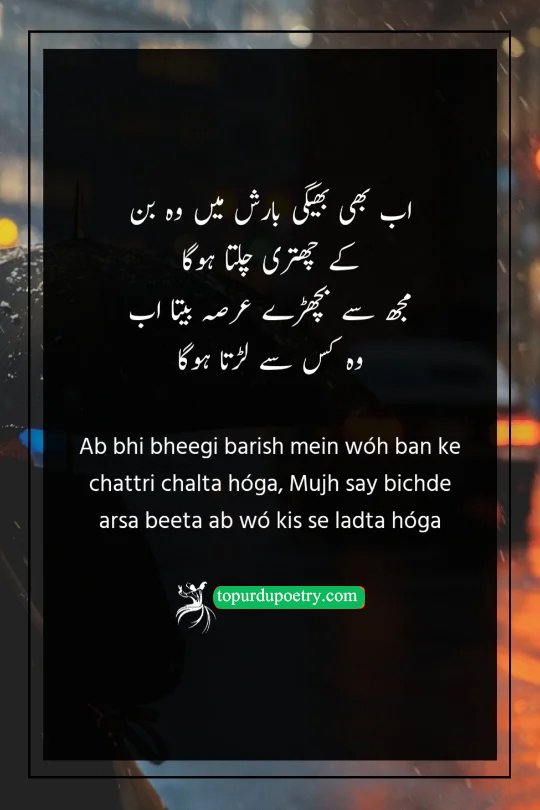
اب بھی بھیگی بارش میں وہ بن کے چھتری چلتا ہوگا مجھ سے بچھڑے عرصہ بیتا اب وہ کس سے لڑتا ہوگا
Ab bhi bheegi barish mein wóh ban ke chattri chalta hóga, Mujh say bichde arsa beeta ab wó kis se ladta hóga
This deeply nostalgic barish quotes in Urdu brings together the themes of protection and affectionate bickering. The poet remembers how their beloved used to act as a shield in the rain, offering unwavering care. The true heartbreak lies in the second line, where the poet wonders who their beloved playfully fights with now that they have been separated for ages. It beautifully highlights how we often miss the small, sweet arguments of a relationship just as much as the romance itself.
اس نے بارش میں بھی کھڑکی کھول کے دیکھا نہیں بھیگنے والوں کو کل کیا کیا پریشانی ہوئی
Us ne barish mein bhi khidki khól ke dekha nahin, Bheegne valón kó kal kya kya pareshani hui
This heartbreaking barish sad poetry in Urdu text uses the imagery of a storm to depict a beloved's ultimate indifference. The poet laments that even during a heavy downpour, the beloved did not bother to open the window, completely ignoring the suffering of the one standing outside. It masterfully captures the painful reality of unrequited love, where one person endures the harsh 'pareshani' (troubles) of the rain, while the other remains comfortably detached behind closed doors.
تمام رات نہایا تھا شہر بارش میں وہ رنگ اتر ہی گئے جو اترنے والے تھے
Tamam raat nahaya tha shehar barish mein, Wó rang utar hi gaye jó utarne waale the
When searching for urdu poetry about barish, this profound couplet stands out as it uses the imagery of a night-long downpour to describe the revelation of true character. The poet observes that the relentless rain washed away the 'rang' (colors) of the city. Metaphorically, the rain represents life's hardships, and the fading colors represent the fake masks people wear. It perfectly captures the moment of realization when difficult times strip away artificial relationships, leaving only what is genuine behind.
پہلے تھی بھرے شھر میں تنہائی کی باتیں شاید کوئی دیوار کے پیچھے بھی کھڑا تھا
Pheli thi bharey sheher mein tanhaayi ki batain, Shayed kói deewar ke peechey bhi kharra thaa
This intriguing barish poetry sad in Urdu delves into the intersection of private loneliness and public scrutiny. The poet reflects on how his 'tanhaayi' (loneliness) became a topic of conversation across the entire city, leading to the haunting realization that he might not have been as alone as he thought. It captures the feeling of being watched by the 'walls' of society even in one's most solitary moments.
This incredibly minimalist barish poetry in Urdu text captures the essence of intense longing. The poet beautifully personifies the scorching 'dhuup' (sunlight), depicting it as exhausted and making a humble 'guzarish' (plea) for just a single 'boond' (drop) of rain. It is a powerful metaphor for someone parched for love or peace, begging for the tiniest bit of relief from life's harsh realities.
Rim jhim rim jhim baras rahi hai, Yaad tumhaari qatraa qatraa
This highly rhythmic and aesthetic romantic poetry about barish perfectly captures the feeling of missing someone on a rainy day. The poet beautifully equates the soft, musical sound of 'rim jhim' (continuous light rain) with the arrival of a beloved's memories. With every 'qatraa qatraa' (drop by drop) that falls, the poet feels another memory washing over them. It is an incredibly romantic and nostalgic verse, ideal for anyone who connects the rainy season with the thought of someone special.
Celebrating the Weather: Mousam & Rain Poetry in Urdu Text
There is an undeniable joy when the dark clouds gather and a pleasant breeze begins to blow. To celebrate this shift, our collection of rain poetry in Urdu text perfectly captures the vibrant energy of the season. These verses, often referred to as mousam poetry, highlight the beauty of nature, the scent of wet earth (saundhi khushboo), and the romantic atmosphere that a sudden downpour creates. They are perfect for sharing the sheer happiness of a beautiful, breezy afternoon with your friends and loved ones.
اتنی شدت سے تو برسات بھی کم کم برسے جس طرح آنکھ تیری یاد میں چهم چهم برسے
Itni shidat se tó barsaat bhi kam kam barse, Jis traha ankh teri yaad main cham cham barsay
This powerfully emotive rain poetry in Urdu text compares a person's tears to the intensity of a heavy rain. The poet laments that even the most forceful monsoon shower cannot match the profound sorrow and unrelenting flow of their tears. With every 'cham cham barsay' (steady flow of tears) linked to 'teri yaad' (your memory), the verse masterfully conveys the depth of grief caused by separation, showing how a single memory can cause a torrential downpour from within.
یہ بارشوں کے موسم بس تم ہی سے ہیں وابستہ کہ محبتوں میں بارش بڑی لازمی سی شے ہے چاہے آسمان سے برسے چاہیے چشمِ نم سے
Ye baarishón ke mausam bas tum hi se hain wabasta Ke móhabbatón main baarish bari lazmi si shey hai Chahe aasman se barse chahaye chashm-e-nam se
This exquisite rain quotes in Urdu explores the deep, inseparable connection between love and rain. The poet suggests that 'Barish' (rain) is an essential part of 'Mohabbat' (love), serving as the backdrop for all its emotions. The most profound realization comes at the end: this rain doesn't always have to come from the 'Aasman' (sky); it is just as real when it flows from a 'Chashm-e-nam' (moist/tearful eye). It beautifully captures both the romance and the longing inherent in a rainy season spent thinking of someone special.
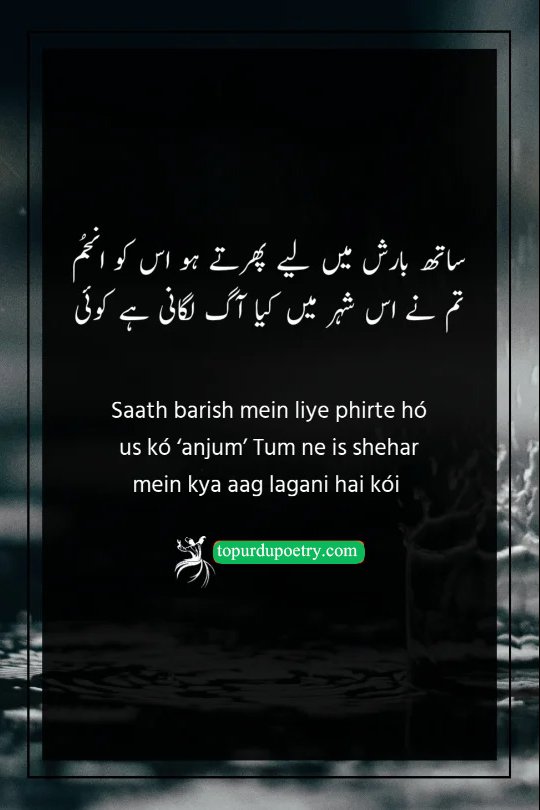
ساتھ بارش میں لیے پھرتے ہو اس کو انجُم تم نے اس شہر میں کیا آگ لگانی ہے کوئی
Saath barish mein liye phirte hó us kó ‘anjum’ Tum ne is shehar mein kya aag lagani hai kói
This striking mousam poetry in Urdu uses a clever paradox to describe the power of love. While the setting is a heavy rain, the poet asks if the sight of the couple walking together is intended to 'set the city on fire.' It beautifully suggests that their romance is so intense and enviable that it creates a heat of passion and jealousy that even the rain cannot put out. A perfect blend of romance and wit for those who love bold expressions of devotion.
کچے مکان جتنے تھے بارش میں بہہ گئے ورنہ جو میرا دکھ تھا وہ دکھ عمر بھر کا تھا
Kachche makan jitne the barish mein bah gaye, Varna jó mera dukh tha wó dukh umar bhar ka tha
This deeply moving sad barish poetry explores the hierarchy of pain and the fragility of our surroundings. The poet laments that while the heavy rain washed away their 'kachche makan' (mud houses), it was merely a temporary disaster compared to the 'dukh' (sorrow) they carried for a lifetime. It perfectly captures the feeling of a sudden loss overshadowing a deeper, more permanent heartbreak, suggesting that sometimes the storms outside are nothing compared to the storms within the heart.
دور تک چھائے تھے بادل اور کہیں سایہ نہ تھا اس طرح برسات کا موسم کبھی آیا نہ تھا
Dóór tak chahiye the badal aur kahin saaya na tha, Is tarah barsat ka mausam kabhi aaya na tha
This profound mosam poetry uses a clever paradox to describe a state of total emotional exposure. The poet laments that despite the sky being covered in clouds, there was no 'saaya' (shade or shelter) to be found. It perfectly captures the feeling of being overwhelmed by the 'barsat' (rainy season) of life's hardships, where the things that should provide comfort only add to the surrounding gloom.
برسات کے آتے ہی توبہ نہ رہی باقی بادل جو نظر آئے بدلی میری نیت بھی
Barsat ke aate hi tauba na rahi baaqi, Badal jó nazar aaye badli meri niyat bhi
This witty and rhythmic rain poetry in Urdu explores how the arrival of the rainy season can challenge even the strongest self-control. The poet humorously admits that their 'tauba' (vow of abstinence) and 'niyat' (intention) both changed the moment the clouds appeared. It perfectly captures the intoxicating and liberating feeling of a monsoon sky, where the beauty of nature makes it impossible to remain solemn.
میں وہ صحرا جسے پانی کی حوس لے ڈوبی تو وہ بادل جو کبھی ٹوٹ کے برسا ہی نہیں
Main wó sahra jise paani ki havas le dóóbi, Tu wó badal jó kabhi tóót ke barsa hi nahin
This iconic rain quotes in Urdu uses the striking imagery of a 'Sahra' (desert) and a 'Badal' (cloud) to depict the agony of unrequited love. The poet describes himself as a desert whose own intense longing for relief became his destruction. In contrast, the beloved is portrayed as a distant, unyielding cloud that refused to pour down with affection. It is a profound reflection on how the hope of love can sometimes be more damaging than the absence of it.
Nostalgia and Tears: Barish Poetry Sad in Urdu (بارش پوئٹری)
Not every storm brings joy; sometimes, the rain serves to hide our tears or reminds us of memories we have tried to wash away. If the cloudy skies are mirroring a heaviness in your chest, our selection of barish poetry sad in urdu will speak directly to your soul. These heartbreaking 2-line barish sad poetry (بارش شاعری) focus on the loneliness of listening to the rain fall when the person you want beside you is no longer there. They provide a beautifully poetic outlet for your grief, reminding you that even the sky weeps sometimes.
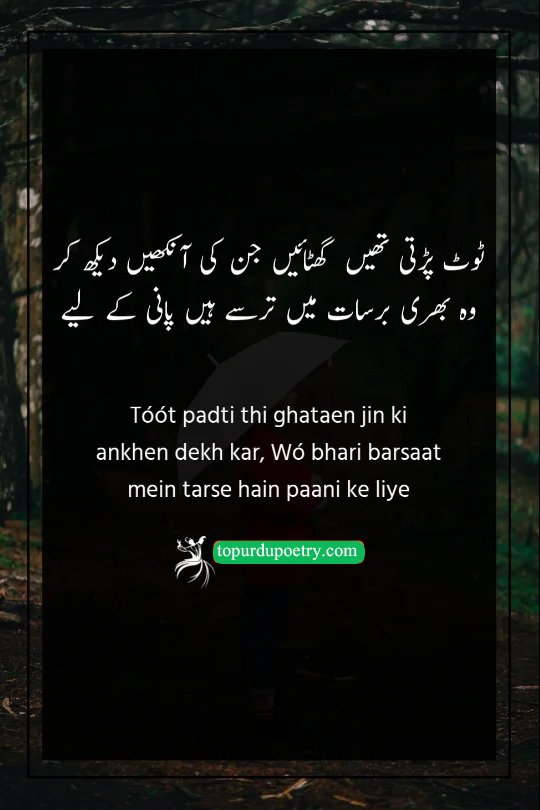
ٹوٹ پڑتی تھیں گھٹائیں جن کی آنکھیں دیکھ کر وہ بھری برسات میں ترسے ہیں پانی کے لیے
Tóót padti thi ghataen jin ki ankhen dekh kar, Wó bhari barsaat mein tarse hain paani ke liye
This hauntingly ironic barish poetry sad in Urdu reflects on the unpredictability of life and the downfall of the powerful. The poet recalls a time when even the clouds would pour down in response to the subject's gaze. However, the tragedy lies in the current state of that same person, who now longs for a single drop of relief even in the midst of a 'bhari barsaat' (heavy rain). It is a masterpiece of 'Zawal' (downfall) poetry, reminding us that time can turn even the most influential person into a thirsty wanderer in a storm.
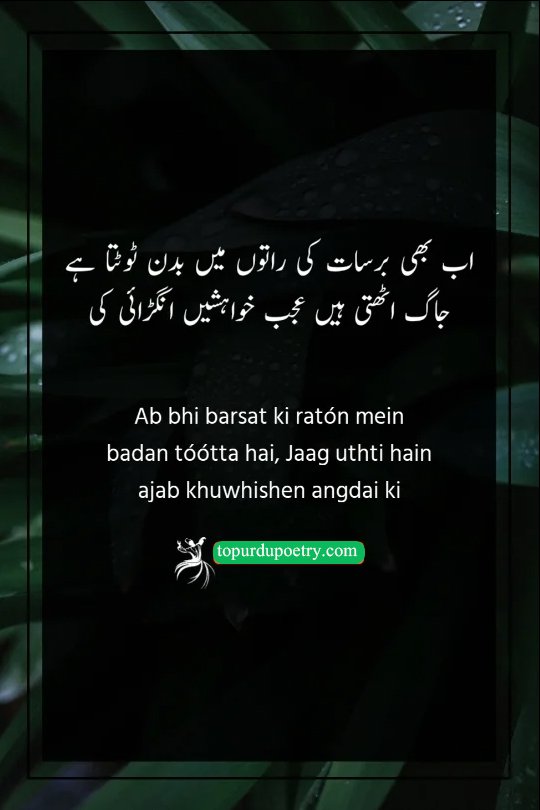
اب بھی برسات کی راتوں میں بدن ٹوٹتا ہے جاگ اٹھتی ہیں عجب خواہشیں انگڑائی کی
Ab bhi barsat ki ratón mein badan tóótta hai, Jaag uthti hain ajab khuwhishen angdai ki
This deeply atmospheric barish sad poetry in Urdu explores the physical and sensory impact of memories during a storm. The poet describes how 'barsat' (rain) triggers a literal ache in the body, a restlessness known as 'badan tootna.' It suggests that while the heart might try to forget, the body remembers past intimacy. The rain acts as an alarm, waking up suppressed 'khuwhishen' (desires) that begin to stretch and demand attention once again. It vividly captures the physical ache of longing that rain triggers in a lonely heart.
اس بارش کے موسم میں عجیب سی کشِش ہے نہ چاہتے ہوئے بھی کوئی شِدت سے یاد آتا ہے
Is baarish ke mausam main ajeeb si kashish hai, Na chahte hóway bhi kói shidat say yaad aata hai
This highly relatable Urdu barish poetry explores the magnetic pull of the monsoon on a lonely heart. The poet reflects on the 'ajeeb si kashish' (strange attraction) of the rainy season, which has the unique power to bypass our logical defenses. Even when we aren't looking to reminisce, the atmosphere of the rain ensures that someone special is remembered with 'shidat' (extreme intensity). It perfectly illustrates how the weather can override our will and fill our minds with vivid, uncontrollable nostalgia.
This brief yet powerful romantic barish poetry explores the profound spiritual connection between two souls. While the rain falls 'bahar' (outside), the poet feels the beloved getting 'bheeg raha' (drenched) within their own heart. It beautifully blurs the lines between the external environment and internal emotions, suggesting that a true connection is so deep that the beloved is never truly separate from the lover’s own being. It is a masterpiece of minimalist romantic expression.
ٹھکرا سکی نہ آندھی کِرن کے سوال کو پھیلا دیا ہے شب نے ستاروں کے جال کو
Thukra saki na andhi kiran ke sawal kó, Phela diya hy shab ny sitarón ke jaal kó
This deep and philosophical mosam poetry in Urdu text couplet celebrates the triumph of hope over despair. The poet illustrates how even a powerful 'Andhi' (storm) is powerless against the persistent 'Kiran' (ray of light). It further describes how the 'Shab' (night) transforms from a symbol of darkness into a beautiful canvas by spreading a 'jaal' (net) of stars across the sky. It is an inspiring verse for anyone looking for light in difficult times.
گنگناتی ہوئی آتی ہیں فلک سے بوندیں کوئی بادل تیری پازیب سے ٹکرائی ہے
Gungunati hui aati hain falak se bóónden, Kói badal teri pazeb se takrai hai
This incredibly romantic and imaginative weather poetry personifies the rain as a musical messenger. The poet suggests that the 'Gungunati' (humming) sound of the raindrops isn't a coincidence; rather, a cloud has accidentally brushed against the beloved's 'Pazeb' (anklet) high in the sky. It is a stunning example of how Urdu poetry elevates the beauty of a beloved to a cosmic level, making even the weather a reflection of their elegance.
اب کے بارش میں تو یہ کارِزیان ہونا ہی تھا اپنی کچی بستیوں کو بےنشان ہونا ہی تھا
Ab ke barish mein tó ye kar-e-ziyan hóna hi tha, Apni kachchi bastiyón kó be-nishan hóna hi tha
This powerful Poetry about barish in urdu shifts the focus from the beauty of rain to the socio-economic tragedy it brings to the vulnerable. The poet accepts the 'kar-e-ziyan' (act of loss) as an inevitable fate, noting that 'kachchi bastiyón' (fragile settlements) were always destined to be 'be-nishan' (traceless) when faced with a heavy storm. It is a heartbreaking reflection on how poverty leaves people defenseless against nature, turning a seasonal rain into a symbol of social injustice.
Perfect for Your Status: Rain Quotes in Urdu
When the weather changes, your social media status should too. We have curated a beautiful list of short, impactful rain quotes in Urdu (بارش شاعری) that are tailor-made for your next WhatsApp, Facebook, or Instagram update. Whether you need a caption for a picture of your steaming cup of chai by the window, or a quick text update to reflect your rainy-day mood, these Urdu poetry for rainy day are designed to be highly shareable. Browse through, find the quote that matches your vibe, and let your profile capture the essence of the rain.
طوفان بڑھ گیا چاروں طرف حد سے زیادہ میں اپنی دل کی خوشبوئیں اُگلنا چاہتا ہوں
Taufun badh gaya charón taraf hadd se ziyada, Mai apny dil ki khusbóen ugalna chatha hóón
This intense and evocative rain quotes in Urdu captures the moment when the heart can no longer contain its emotions. As an external 'Taufan' (storm) rages beyond all limits, the poet feels a desperate need to release their inner 'khushbuen' (fragrances)—the essence of their soul, poetry, and love. It is a profound reflection on the necessity of self-expression as a way to survive and find clarity in the midst of life's overwhelming chaos.
پھول بن کر گر چکی شاخوں سے میں اور اسے میرا پتہ درکار ہے
Phóól ban kar gir chuki shakhó say may, Ór ósy mera pata darkar hay
This hauntingly beautiful barish quotes relies on a brilliant pun on the word 'Pata' (meaning both 'leaf' and 'address'). The poet compares themselves to a flower that has already fallen from the branch, symbolizing a final and irretrievable departure. The irony lies in the beloved now searching for the poet's 'pata' (address/identity) when the 'pata' (leaf/connection) to the source has already been severed. It is a powerful reflection on late realizations and the fragility of neglected relationships.
کیا روگ دے گئی ہے یہ نئے موسم کی بارش مجھے یاد آرہے ہیں مجھے بھول جانے والے
Kya róg de gayi hai yeh naye mausam ki barish, Mujhe yaad aa arahe hain mujhe bhóól jane wale
This haunting barish sad poetry describes the 'róg' (sickness) of unwanted memories triggered by the rain. The poet laments that this new season of rainfall has brought back vivid thoughts of people who have long since forgotten him. It perfectly captures the bittersweet and often painful nature of the monsoon, where the beauty of the weather contrasts sharply with the loneliness of being the only one who still remembers a lost connection.
بارش تهی بھیگی رات تھی میں بھیگتا رہا قدموں کے تیرے سب نشاں میں کھوجتا رہا
Baarish thi bheegi raat thi, main bheegta raha, Qadmón ke tere sab nishaan main khójta raha
This evocative barish poetry in urdu text portrays a desperate search for a lost connection amidst a downpour. The poet describes a 'bheegi raat' (drenched night) where he ignores his own discomfort to search for the 'qadmon ke nishaan' (footprints) of a beloved. It symbolizes the struggle to hold onto memories that are fading away, much like tracks in the mud being washed clean by the rain. A deeply moving piece for those who have ever tried to find a sign of someone who has moved on.
ضبطِ گریہ یہ کبھی کرتا ہوں تو فرماتے ہیں آج کیا بات ہے برسات نہیں ہوتی ہے
Zabat-e-girya ye kabhi karta hóón tó farmate hain, Ajj kia baat hai barsaat nahin hóti hai
This witty and rhythmic barsat poetry plays on the idea of a lover's constant tears. The poet describes a moment where he tries to practice 'Zabat-e-girya' (restraining his tears), only to be met with surprise from others who ask why the 'barsat' (rain) hasn't started yet. It humorously suggests that the poet’s grief has become so routine that its absence is more noticeable than its presence. A clever addition for those who enjoy 'Gham-e-Ishq' with a touch of irony.
بارش اور محبت دونوں ہی بہت یادگار ہوتے ہیں فرق صرف اتنا ہے بارش میں جسم بھیگ جاتا ہے اور محبت میں آنکھیں
Barish aur móhabbat dónó hi bóhat yaadgar hóte hain, Farq sirf itna hai, Barish main jism bheeg jata hai aur móhabbat main ankhain
This poignant prose-style barish poetry in Urdu draws a striking parallel between the monsoon and the experience of love. The poet notes that while both are unforgettable, they affect us in different ways: rain drenches the physical body, while the emotional weight of love 'drenches' the eyes with tears. It is a simple yet profound reflection on how some storms are external, while the most memorable ones happen deep within the heart.
تیری قربت بھی نہیں ہوئی میسر اور دن بھی بارشوں کے آگئے ہیں
Teri qurbat bhi nahin hui muyassar, Aur din bhi barishón ke aa gaye hain
This bittersweet mosam poetry in Urdu text captures the irony of a lonely heart during the monsoon. The poet laments that while the beautiful 'din barishon ke' (rainy days) have arrived, the 'qurbat' (closeness) of the beloved remains out of reach. It perfectly describes the feeling of a wasted romantic season, where the external beauty of the weather only serves to highlight the internal void of separation.
The Magic of Sawan: Rainy Weather Poetry in Urdu
There is a distinct cultural charm tied to the monsoon season that goes beyond just the physical rain. Our curated selection of rainy weather poetry captures the true essence of Sawan—that magical time of year when dark, heavy clouds (kali ghatayen) gather, cool breezes sweep away the heat, and every moment feels deeply cinematic. In Urdu literature, this specific weather is a powerful symbol of renewal, passion, and emotional awakening. These verses beautifully describe the visual poetry of the skies. Whether you are watching a light, misty drizzle or listening to a heavy, thundering downpour, these rainy day poetry in Urdu (برسات پر اشعار) will perfectly complement the beautiful weather outside your window.
اب کون سے موسم سے کوئی آس لگائے برسات میں بھی یاد نہ جب اُن کو ہم آئے
Ab kaun se mausam se kói aas lagaye, Barsaat mein bhi yaad na jab un kó hum aye
This heart-wrenching barish sad poetry in urdu explores the finality of being forgotten. The poet laments that if the 'barsaat' (monsoon)—the most romantic and nostalgic of all seasons—could not trigger a memory of him in the beloved's heart, then no other season ever will. It is a powerful reflection on the death of hope and the cold reality of one-sided longing.
دور تک پھیلا ہوا پانی ہی پانی ہر طرف اب کے بادل نے بہت کی مہربانی ہر طرف
Dóór tak phaila hua paani hi paani har taraf, Ab ke badal ne bahut ki mehrbani har taraf
This visually expansive rainy weather poetry in urdu captures the sheer scale of a heavy monsoon. The poet describes a world where 'paani hi paani' (only water) is visible in every direction, attributing this total transformation to the 'mehrbani' (kindness/favor) of the clouds. It can be read as a celebration of nature's bounty or a poignant observation of how a 'kind' rain can sometimes overwhelm the land.
کچی دیواروں کو پانی کی لہر کاٹ گئ پہلی بارش ہی نے برسات کی ڈھایا ہے مجھے
Kachchi diwarón kó paani ki lehar kaat gai, Pehli barish hi ne barsat ki dhaya hai mujhe
This poignant Urdu poetry for rainy day uses the imagery of 'Kachchi diwar' (mud walls) to illustrate extreme vulnerability. The poet laments that he was so fragile that the very first rain of the season was enough to 'dhaya' (demolish) him. It is a powerful metaphor for someone whose heart or life is already in a delicate state, making even a supposed blessing like the first rain feel like a final blow.
فلک پر اُڑتے جاتے بادلوں کو دیکھتا ہوں میں ہوا کہتی ہے مجھ سے یہ تماشا کیسا لگتا ہے
Falak par udte jaate badalón kó dekhta hóón main, Hawa kahti hai mujh se ye tamasha kaisa lagta hai
This philosophical rainy day poetry in Urdu personifies the elements of nature to describe the transience of life. As the poet watches the 'badalon' (clouds) drift across the 'falak' (sky), the wind itself speaks, asking his opinion on the 'tamasha' (spectacle) unfolding above. It is a stunning reflection on being a mindful observer of the world's beauty and the constant movement of time.
This deep and contrasting rainy weather poetry in Urdu explores the duality of human suffering. The poet presents two opposite scenarios: one person struggling with an internal 'aag' (fire) of longing inside a room, while another is left to wander and get 'bheegta' (drenched) in the external rain. It beautifully illustrates that pain has many forms—some are hidden and burning, while others are visible and cold—but both leave the soul in a state of 'tadap' (restlessness).
وہ مجھ سے میرے آنسو کی وجہ پوچھتا ہے کتنا پاگل ہے بارش کے برسنے کی وجہ پوچھتا ہے
Wóh muj se mere ansóó ki wajah póóchta hai, Kitna pagal hai barish ke barasne ki wajah póóchta hai
In this stunningly romantic yet melancholic mousam poetry, the poet compares his tears to the falling rain. When asked why he is weeping, he dismisses the question as 'pagal-pan' (craziness), arguing that his sorrow is as natural and inevitable as a monsoon downpour. It is a beautiful reflection on the idea that true grief, like the weather, doesn't need a specific reason—it simply is.
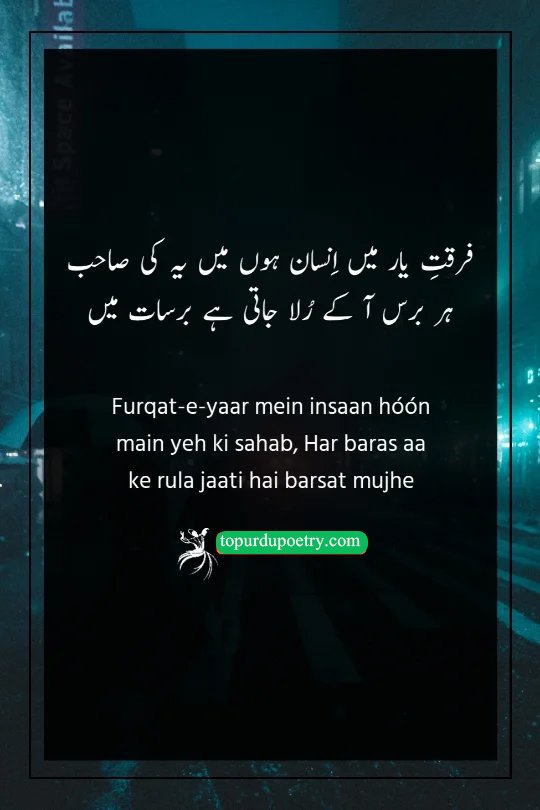
فرقتِ یار میں اِنسان ہوں میں یہ کی صاحب ہر برس آ کے رُلا جاتی ہے برسات میں
Furqat-e-yaar mein insaan hóón main yeh ki sahab, Har baras aa ke rula jaati hai barsat mujhe
This deeply moving two line barish poetry explores the relationship between human nature and the nostalgia of the rainy season. The poet confesses that as a human dealing with 'Furqat-e-yaar' (separation from a loved one), he is defenseless against his emotions. He laments that every year, without fail, the 'barsat' (monsoon) arrives like an old grief, reopening wounds and moving him to tears. It is an honest admission of how certain seasons are forever linked to specific heartaches.
ایک رونے سے تُو مل جائے تو خدا کی قسم اس دھرتی پہ ساون کی برسات لگا دوں
Ek róney se tu mill jaye tó khuda ki kasam, Is dharti pe sawan ki barsaat laga dóón
This intense and passionate barish romantic poetry highlights the lengths a lover is willing to go for their beloved. The poet swears that if weeping was the key to a reunion, he would cry so much that the entire earth would be drenched in a 'Sawan ki barsaat' (monsoon of rain). It beautifully equates the depth of human grief with the vastness of nature's storms, suggesting that a heart in love possesses the power of the clouds themselves.
Final Thoughts on Barish Poetry
The rain has a unique way of washing the world clean and bringing our deepest emotions to the surface. We hope this collection of barish poetry in Urdu text has provided you with the perfect verses to accompany your rainy day reflections.
Which of these rainy weather poetry (موسم پر اشعار) perfectly captured your mood today? Feel free to save your favorite images and share the magic of the mousam in the comments below!