In the world of classic romance, few things have inspired writers quite like the beauty of a beloved’s hair. Whether compared to the dark, gathering clouds of a monsoon or the mysterious depths of a moonless night, the art of poetry on hairs in Urdu holds a very special place in literature. For centuries, poets have used the metaphor of the “zulf” (tresses or locks) to describe the captivating, almost magical hold someone can have over their heart. If you are looking to compliment someone’s beauty in the most poetic way possible, sharing hairs poetry in Urdu is an incredibly elegant and timeless approach.
Beyond just physical beauty, there is a deep emotional connection attached to these romantic descriptions. When you explore poetry about hair in Urdu, you are tapping into a long tradition of expressing admiration, fascination, and deep affection. The delicate way a breeze plays with someone’s curls has been the muse for countless legendary couplets. Whether you want a short verse for an Instagram caption or a deeper couplet to share your feelings directly, our collection of zulfain poetry on hair in Urdu offers the perfect words.
Interestingly, experts who study the psychology of hair note that healthy, flowing hair has always been a powerful, universal symbol of vitality and romance across human history, which explains exactly why it remains such a dominant theme in love poetry today.
Table of Contents
The Magic of Zulfain: Hairs Poetry in Urdu
In Urdu shayari, hair is rarely just hair. It is described as a beautiful chain that binds the lover, or a fragrant shadow that provides peace to a restless heart. By reading through these couplets of hairs poetry in Urdu, you get a glimpse into how master poets turned a simple physical feature into a sweeping landscape of emotion and romance. These short, two-line verses of poetry on hairs in Urdu perfectly capture that breathtaking moment when you are completely captivated by someone’s presence.
نہ جھٹکو زلف سے پانی یہ موتی ٹوٹ جائیں گے تمہارا کچھ نہ بگڑے گا مگر دل ٹوٹ جائیں گے
Na jhatko zulf se paani ye moti tuut jaenge Tumhara kuchh na bigdega magar dil tuut jaenge
This iconic couplet of poetry on hairs in Urdu by Qamar Jalalvi is a stunning example of romantic imagery. The poet views water droplets in the beloved’s hair as precious 'moti' (pearls) and pleads for them not to be shaken away. It highlights the contrast between the beloved's casual actions and the devastating impact those actions have on the admirer's heart. It beautifully illustrates how, in the world of love, even a falling drop of water can carry the weight of a breaking heart.
نیند اس کی ہے دماغ اس کا ہے راتیں اس کی ہیں تیری زلفیں جس کے بازو پر پریشاں ہو گئیں
Niind us ki hai dimagh us ka hai raten us ki hain Teri zulfen jis ke baazu par pareshan ho gaiin
This legendary poetry for hairs in urdu by Mirza Ghalib defines the ultimate envy and fulfillment of a lover. He claims that only the man on whose arm the beloved’s 'zulfen' (tresses) are scattered can truly enjoy 'niind' (sleep) and 'dimagh' (peace of mind). It beautifully illustrates how the physical presence of the beloved transforms a restless night into a sanctuary of absolute calm and belonging.
بہت مشکل ہے دنیا کا سنورنا تری زلفوں کا پیچ و خم نہیں ہے
Bahut mushkil hai duniya ka sanvarna Teri zulfon ka pech-o-kham nahin hai
In this witty and profound couplet, the poet compares the complexities of the world to the tangled tresses of the beloved. He argues that while the 'pech-o-kham' (curls and twists) of hair can be easily groomed and straightened, fixing the chaos of the world is a far more difficult task. It is a masterful blend of romance and social philosophy, suggesting that human beauty is simple, but human society is incredibly tangled.
یہ اڑی اڑی سی رنگت یہ کھلے کھلے سے گیسو تری صبح کہہ رہی ہے تری رات کا فسانہ
Ye udi udi si rangat ye khule khule se gesu Teri subh kah rahi hai teri raat ka fasana
This subtle and evocative couplet of hairs poetry in Urdu captures the beauty of a morning after a restless night. By observing the beloved's 'udi udi si rangat' (faded complexion) and 'khule khule se gesu' (scattered hair), the poet suggests that their appearance tells a silent 'fasana' (story) of the night's events. It is a brilliant example of how physical details can reveal the deepest secrets of the heart.
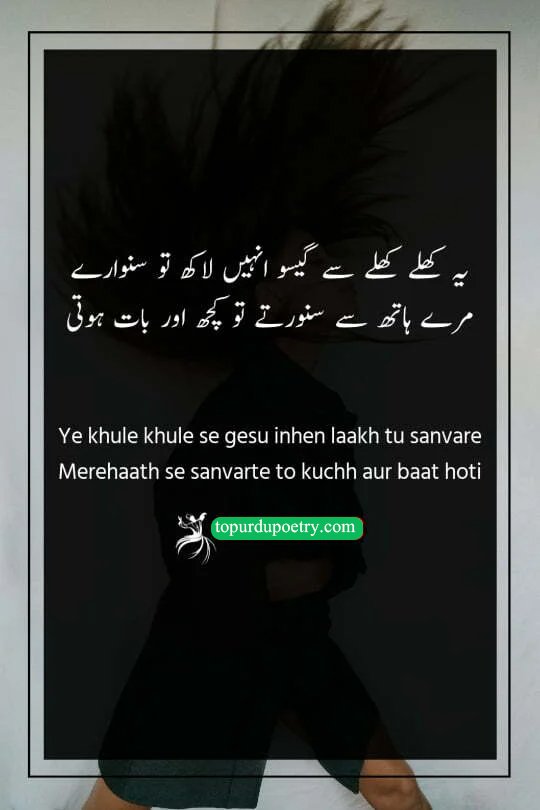
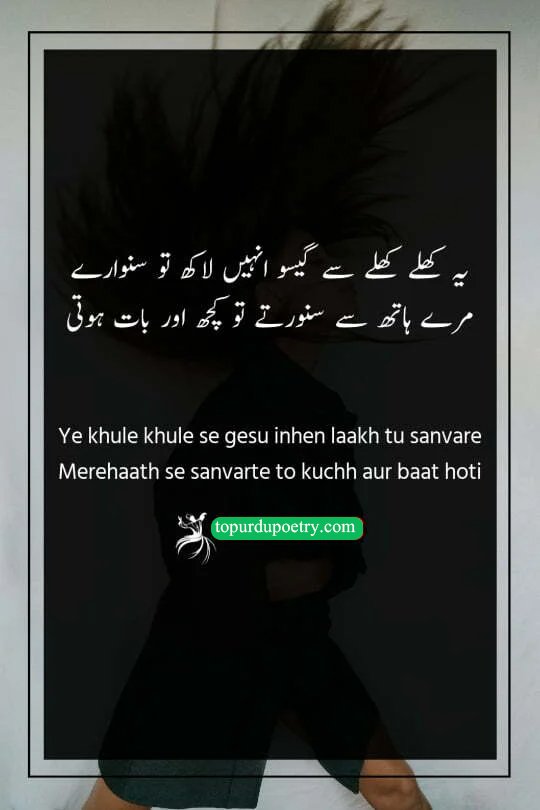
یہ کھلے کھلے سے گیسو انہیں لاکھ تو سنوارے مرے ہاتھ سے سنورتے تو کچھ اور بات ہوتی
Ye khule khule se gesu inhen laakh tu sanvare Mere haath se sanvarte to kuchh aur baat hoti
In this charming and romantic poetry on hairs in urdu , the poet expresses a playful desire for intimacy. He tells the beloved that no matter how much effort they put into grooming their own 'gesu' (tresses), the result would be far more magical if his own hands were doing the work. It beautifully captures the sentiment that love adds a grace to beauty that self-care alone cannot achieve.
کچھ بکھری ہوئی یادوں کے قصے بھی بہت تھے کچھ اس نے بھی بالوں کو کھلا چھوڑ دیا تھا
Kuchh bikhri hui yadon ke qisse bhi bahut the Kuchh us ne bhi balon ko khula chhod diya tha
In this melancholic and evocative verse, the poet draws a parallel between the 'bikhri hui yadein' (scattered memories) of his past and the 'khule baal' (open hair) of his beloved. He suggests that the sight of her untied tresses amplified the chaos within his own heart, making it impossible to escape the stories of the past. It is a beautiful reflection on how external beauty can mirror and stir our deepest internal emotions.
اپنے سر اک بلا تو لینی تھی میں نے وہ زلف اپنے سر لی ہے
Apne sar ik bala to leni thi Main ne vo zulf apne sar li hai
This witty and daring poetry for hairs plays with the idiom of taking on a 'Bala' (calamity). The poet suggests that since life requires one to carry some sort of burden or passion, he has chosen the 'Zulf' (tresses) of his beloved as his beautiful obsession. It perfectly captures the spirit of a lover who finds joy in the 'trouble' that love brings. A unique addition for your 'Zulf' or 'Love & Obsession' categories.
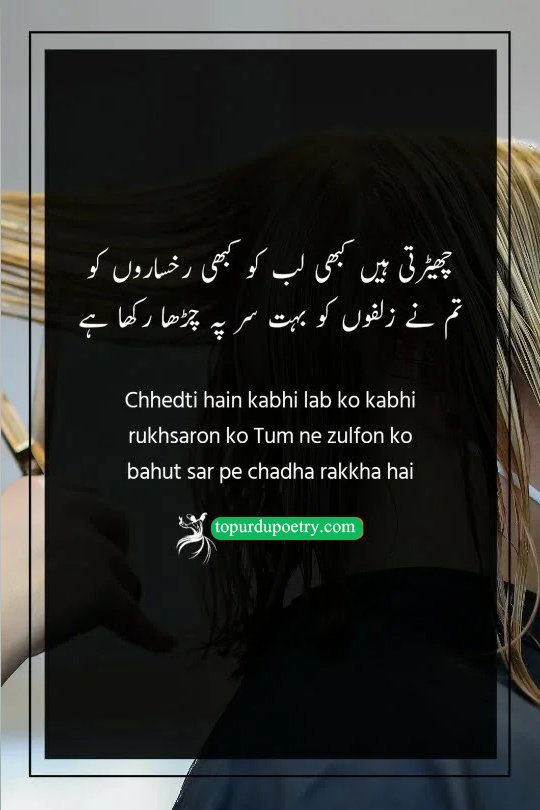
چھیڑتی ہیں کبھی لب کو کبھی رخساروں کو تم نے زلفوں کو بہت سر پہ چڑھا رکھا ہے
Chhedti hain kabhi lab ko kabhi rukhsaron ko Tum ne zulfon ko bahut sar pe chadha rakkha hai
This witty and playful couplet of hairs poetry in Urdu is a masterpiece of double meaning. The poet 'complains' to the beloved that their hair has become too spoiled and mischievous, constantly teasing their lips and cheeks. By using the idiom 'Sar pe chadhana' (which means both 'to put on the head' and 'to pamper'), the verse adds a layer of charm and humor to the traditional admiration of beauty.
کس نے بھیگے ہوئے بالوں سے یہ جھٹکا پانی جھوم کے آئی گھٹا ٹوٹ کے برسا پانی
Kis ne bhige hue balon se ye jhatka paani Jhuum ke aai ghata tuut ke barsa paani
This breathtaking couplet uses the metaphor of a rain-heavy cloud ('Ghata') to describe the beloved's wet hair. The poet marvels at the sight of someone shaking water from their tresses, claiming that the action was so powerful it felt as if a storm had suddenly arrived and the rain had started to pour.
Express Your Admiration with Poetry About Hair in Urdu
Sometimes, a direct compliment can feel a bit too simple. That is when poetry steps in. Sending a beautiful verse of zulfain poetry on hair in Urdu is a subtle, sophisticated way to make someone feel truly seen and appreciated. Our curated list makes it easy to find a couplet that matches your exact feelings. Whether you are looking for something deeply romantic, slightly playful, or classically profound to share on your WhatsApp status, exploring poetry about hair in Urdu gives you the perfect words to leave a lasting impression.
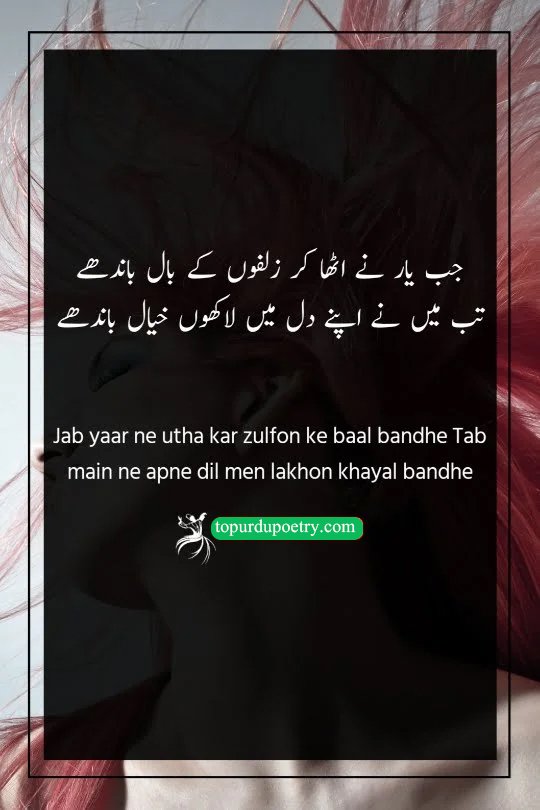
جب یار نے اٹھا کر زلفوں کے بال باندھے تب میں نے اپنے دل میں لاکھوں خیال باندھے
Jab yaar ne utha kar zulfon ke baal bandhe Tab main ne apne dil men lakhon khayal bandhe
This elegant long hair poetry in urdu explores the deep connection between a beloved's actions and a lover's imagination. As the beloved lifts and ties their 'zulf' (tresses), the poet finds himself 'tying' millions of thoughts and dreams within his own heart. It beautifully illustrates how the simple, rhythmic act of fixing a physical lock of hair can trigger an entire universe of unspoken emotions and fantasies in the soul of the observer.
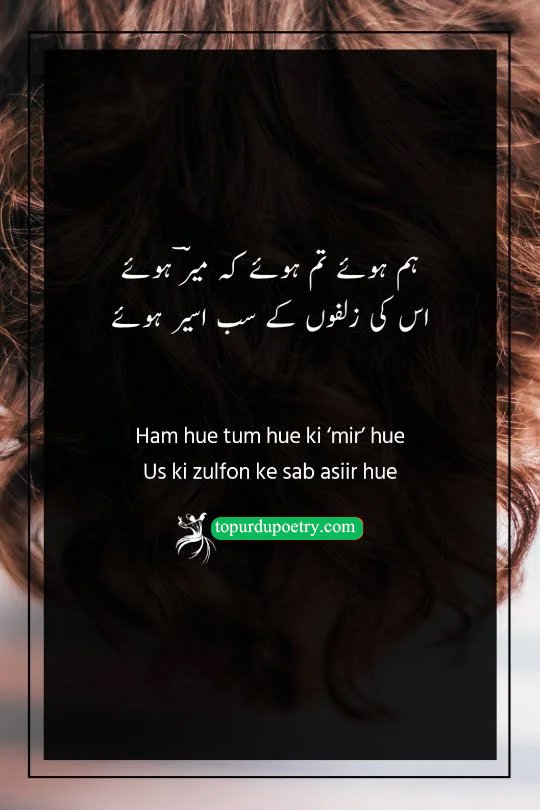
ہم ہوئے تم ہوئے کہ میرؔ ہوئے اس کی زلفوں کے سب اسیر ہوئے
Ham hue tum hue ki ‘mir’ hue Us ki zulfon ke sab asiir hue
This iconic verse by Mir Taqi Mir highlights the inescapable and universal allure of the beloved's tresses. By grouping himself with the listener and everyone else, the poet suggests that 'Zulf' is a magnetic force that takes everyone 'Asiir' (prisoner). It portrays beauty not as a choice, but as a graceful trap that binds all of humanity regardless of their status or wisdom. Truly, in the presence of such grace, the heart finds its only freedom in captivity.
یہ کھلے کھلے سے گیسو انہیں لاکھ تو سنوارے مرے ہاتھ سے سنورتے تو کچھ اور بات ہوتی
Ye khule khule se gesu inhen laakh tu sanvare Mere haath se sanvarte to kuchh aur baat hoti
In this charming and romantic couplet, the poet expresses a playful desire for intimacy. He tells the beloved that no matter how much effort they put into grooming their own 'gesu' (tresses), the result would be far more magical if his own hands were doing the work. It captures that unique romantic confidence where a lover believes their touch is the only thing that can truly complete the beloved's beauty.
دیکھی تھی ایک رات تری زلف خواب میں پھر جب تلک جیا میں پریشان ہی رہا
Dekhi thi ek raat teri zulf khvab men Phir jab talak jiya main pareshan hi raha
In this hauntingly beautiful poetry about hair in urdu , the poet describes the lifelong impact of a single dream. He uses the word 'Pareshan' with a brilliant double meaning: it describes both the scattered, untied state of the beloved's 'zulf' (tresses) and his own state of mental restlessness. It suggests that once the soul witnesses such an overwhelming beauty—even in a dream—it can never return to its former peace. The memory of those flowing tresses became a permanent disturbance, proving that some visions are so powerful they can rewrite a person's destiny forever.
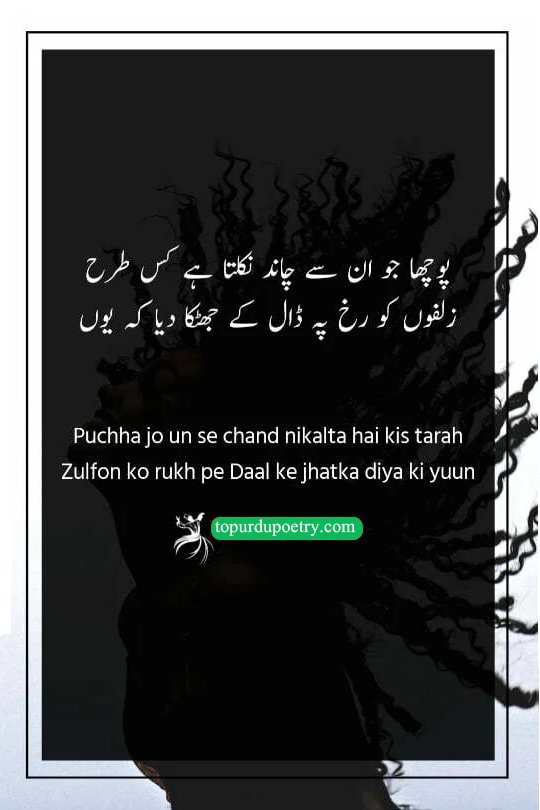
پوچھا جو ان سے چاند نکلتا ہے کس طرح زلفوں کو رخ پہ ڈال کے جھٹکا دیا کہ یوں
Puchha jo un se chand nikalta hai kis tarah Zulfon ko rukh pe Daal ke jhatka diya ki yuun
In this witty and iconic couplet, the poet asks a playful question about how the moon rises. The beloved responds not with words, but with a stunning gesture—covering their face with dark 'zulf' (tresses) and then shaking them away to reveal their radiant beauty. It suggests that the rising of the moon is nothing compared to the sight of the beloved's face emerging from the darkness of their hair. A brilliant example of romantic 'shokhi' that will captivate your readers.
زاہد نے مرا حاصل ایماں نہیں دیکھا رخ پر تری زلفوں کو پریشاں نہیں دیکھا
Zahid ne mera hasil-e-iman nahin dekha Rukh par teri zulfon ko pareshan nahin dekha
In this profound and daring verse, the poet contrasts the dry rituals of the 'Zahid' (ascetic) with the spiritual power of beauty. He suggests that his true faith is not found in books or formal worship, but in the divine sight of the beloved’s scattered 'zulfain' (tresses). It is a masterpiece of the Sufi-romantic tradition, where the perfection of the beloved is seen as the ultimate proof and reward of a lover's devotion. It captures the idea that some visions are so sacred they become a religion of their own.
دیکھ لیتے جو مرے دل کی پریشانی کو آپ بیٹھے ہوئے زلفیں نہ سنوارا کرتے
Dekh lete jo mere dil ki pareshani ko Aap baithe hue zulfen na sanvara karte
In this poignant and witty couplet, the poet contrasts his internal 'pareshani' (distress) with the beloved’s calm act of 'sanvarna' (grooming). He suggests that the beloved is unaware of the havoc their beauty wreaks on his heart; otherwise, they wouldn't spend so much time making their 'zulf' (tresses) even more captivating. It is a masterful expression of the idea that while a beloved may be fixing a stray lock of hair, they are unintentionally unsettling the very soul of the lover.
The Deep Symbolism Behind Zulf Shayari
The way dark, flowing tresses frame a face has inspired generations of writers to explore themes of mystery, beauty, and deep longing. When you share zulfain poetry on hair in Urdu, you are not just praising a physical attribute; you are expressing how entirely someone’s presence has entangled your heart. In classic literature, hair is often compared to a beautiful, inescapable net or the mesmerizing dark clouds of a monsoon. Exploring this specific style of poetry on hairs in Urdu allows you to connect with an age-old tradition, turning a simple glance at someone’s locks into an unforgettable romantic declaration.
بکھری ہوئی وہ زلف اشاروں میں کہہ گئی میں بھی شریک ہوں ترے حال تباہ میں
Bikhri hui vo zulf isharon men kah gai Main bhi sharik huun tere hal-e-tabah men
This poignant verse creates a beautiful bond between the lover's suffering and the beloved's appearance. The poet interprets the 'bikhri' (scattered) state of the tresses as a silent gesture of solidarity. It suggests that the beloved’s beauty isn't just a distant spectacle, but something that mirrors and shares in the poet's 'hal-e-tabah' (ruined state). It is a masterful reflection on how we find comfort in the idea that even the most beautiful things can experience chaos alongside us.
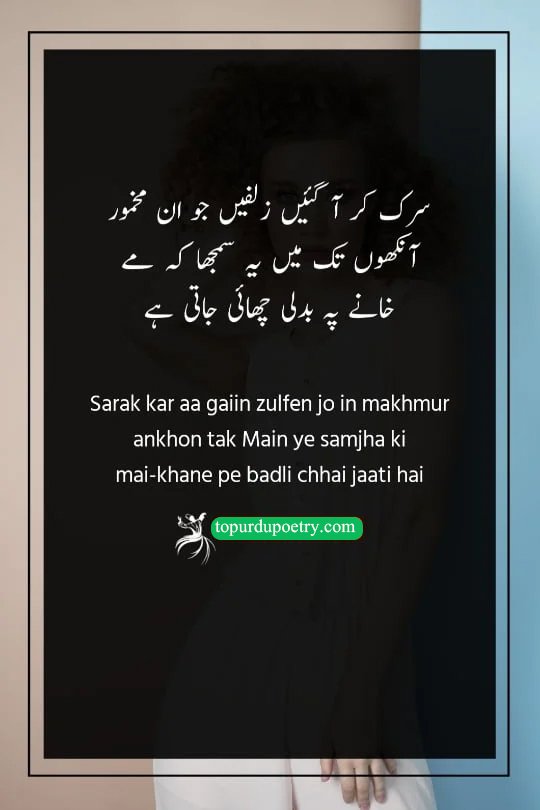
سرک کر آ گئیں زلفیں جو ان مخمور آنکھوں تک میں یہ سمجھا کہ مے خانے پہ بدلی چھائی جاتی ہے
Sarak kar aa gaiin zulfen jo in makhmur ankhon tak Main ye samjha ki mai-khane pe badli chhai jaati hai
In this intoxicatingly beautiful hairs in urdu, the poet creates a vivid comparison between the beloved’s eyes and a tavern. When the dark 'zulf' (tresses) slip down to veil those 'makhmur' (drunken) eyes, the poet feels as though a cooling cloud has gathered over a place of wine. It captures the heavy, atmospheric beauty of a moment where physical grace and spiritual intoxication meet, suggesting that even a single stray lock of hair can transform the entire scene into a masterpiece of nature.
ہاتھ ٹوٹیں میں نے گر چھیڑی ہوں زلفیں آپ کی آپ کے سر کی قسم باد صبا تھی میں نہ تھا
Haath tuten main ne gar chhedi hon zulfen aap ki Aap ke sar ki qasam bad-e-saba thi main na tha
In this witty and playful poetry for hairs in urdu , the poet uses a clever 'innocent lie' to cover up a moment of romantic mischief. After being accused of touching the beloved's hair, he swears a dramatic oath only to shift the blame onto the 'Bad-e-Saba' (morning breeze). It perfectly illustrates the charming, lighthearted side of romance where even a small lie becomes a beautiful expression of intimacy. A must-have for your 'Shokhi' or 'Romantic' categories.
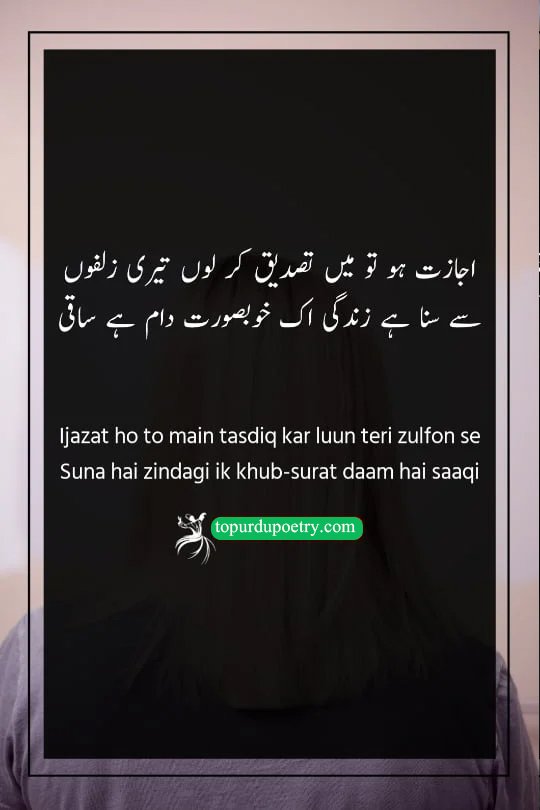
اجازت ہو تو میں تصدیق کر لوں تیری زلفوں سے سنا ہے زندگی اک خوبصورت دام ہے ساقی
Ijazat ho to main tasdiq kar luun teri zulfon se Suna hai zindagi ik khub-surat daam hai saaqi
This sophisticated poetry on hairs in Urdu cleverly merges deep philosophy with romantic admiration. The poet seeks to 'tasdiq' (verify) the ancient saying that life is a 'khubsurat daam' (beautiful trap) by comparing it to the enchanting tresses of the Saki. It captures the bittersweet realization that some traps are so breathtakingly beautiful that the human heart never truly wishes to be free from them.
اے جنوں پھر مرے سر پر وہی شامت آئی پھر پھنسا زلفوں میں دل پھر وہی آفت آئی
Ai junun phir mere sar par vahi shamat aai Phir phansa zulfon men dil phir vahi aafat aai
In this intense and rhythmic verse, the poet addresses his own madness ('Junun'), lamenting that his heart has once again been trapped in the 'zulf' (tresses) of the beloved. It captures the recurring cycle of love where the heart, despite knowing the trials of the past, finds itself helplessly entangled in the same beautiful 'aafat' (calamity). It is a powerful expression of the idea that some obsessions are impossible to escape, even when we know they lead to trouble.
Zulfen siina naaf kamar Ek nadi mein kitne bhanvar
In this bold and highly visual couplet, the poet compares the physical beauty of the beloved to a flowing river. By describing the 'zulfen' (tresses), waist, and other features as 'bhanvar' (whirlpools), the verse suggests that each attribute is a captivating trap for the lover’s heart. It perfectly illustrates the overwhelming power of 'Husn' (beauty), where the observer finds themselves pulled into an endless depth of admiration from which there is no escape.
پھر یاد بہت آئے گی زلفوں کی گھنی شام جب دھوپ میں سایہ کوئی سر پر نہ ملے گا
Phir yaad bahut aayegi zulfon ki ghani shaam Jab dhuup men saaya koi sar par na milega
This soul-stirring long hair poetry in Urdu uses the metaphor of 'Dhuup' (sunlight) and 'Saaya' (shadow) to describe the protective nature of love. The poet suggests that the beloved's dark tresses are like a cooling evening that shields the lover from the harsh realities of life. It serves as a haunting reminder that the comfort and peace found in the presence of a loved one are often only fully appreciated when one is left alone to face the scorching hardships of the world.
Final Thoughts on Zulf Shayari
Praising a loved one’s beauty through zulfain poetry on hairs in Urdu is a tradition that will never lose its charm. We hope this collection provided you with the perfect, elegant words to express your admiration and leave a lasting impression.
Which of this poetry on hairs in Urdu is your absolute favorite? Do you have a classic couplet about zulfain that always comes to mind?
Share your thoughts in the comments below! Don’t forget to download our custom shayari images for your WhatsApp and Facebook statuses. For more romantic verses, be sure to explore our Beautiful Face Poetry in Urdu.