The feeling of being betrayed by someone you trusted is one of the most difficult emotions to put into words. In the world of literature, bewafa poetry in Urdu has always been a powerful way to express this deep pain, helping the heart heal through the beauty of words. Whether you are dealing with a recent heartbreak or simply reflecting on the nature of shifting loyalties, our collection of bewafa shayari urdu offers a voice to your silent tears. These verses capture the essence of broken promises and the cold reality of those who choose to walk away when they were needed the most.
Sometimes, a single quote can explain a thousand feelings. Sharing bewafa quotes in urdu is not just about expressing sadness; it is about finding a connection with others who have felt the same way. When we encounter bewafa log poetry, we realize that unfaithfulness is a part of the human experience that poets have explored for centuries.
Interestingly, experts who study the psychology of heartbreak note that expressing grief through art or writing is a vital step in moving forward and finding peace. By reading and sharing these two-line couplets, you allow yourself the space to acknowledge your pain and eventually let it go.
If you are looking for more ways to express your deep emotions, you might also find comfort in our collection of Yaad Poetry in Urdufor those quiet, reflective moments.
Table of Contents
Heart Touching Bewafa Shayari Urdu for Status
When words are not enough to describe the void left by a broken promise, bewafa poetry in Urdu steps in. Our curated list of bewafa shayari urdu (بےوفا شاعری) is designed to be shared. These short, meaningful lines are perfect for your WhatsApp or Facebook status, letting the world know the depth of your feelings without saying too much. Each couplet is a reflection of the trust that was once there and the lessons learned from a person’s unfaithfulness.
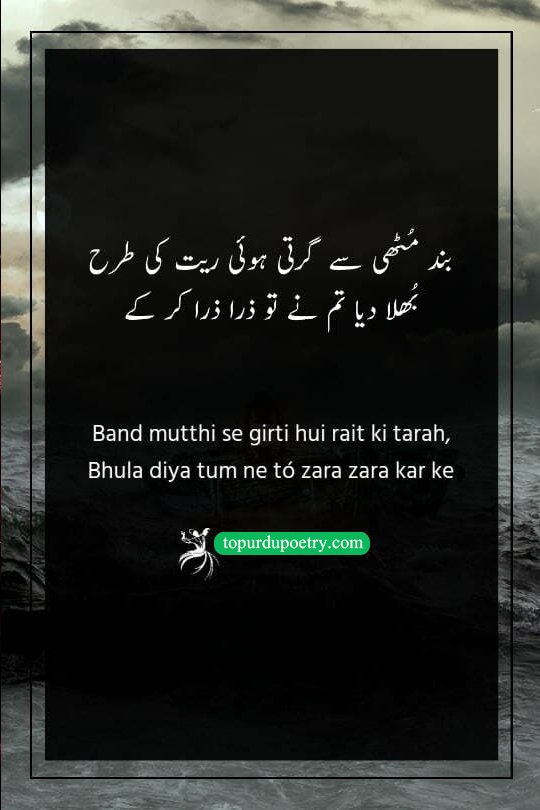
بند مُٹھی سے گرتی ہوئی ریت کی طرح بُھلا دیا تم نے تو ذرا ذرا کر کے
Band mutthi se girti hui rait ki tarah Bhula diya tum ne to zara zara kar ke
In this poignant and highly relatable bewafa dost poetry in urdu, the poet uses the timeless metaphor of sand slipping through a fist to describe the slow loss of a relationship. It captures the 'Azaab' (torment) of watching someone let go of you not all at once, but in tiny, daily increments. While the poet tried to hold on tight, the beloved chose the path of 'zara zara' (bit by bit) forgetting. It is a masterpiece for those who have experienced the quiet, slow-motion heartbreak of becoming a stranger to someone who once knew them completely.
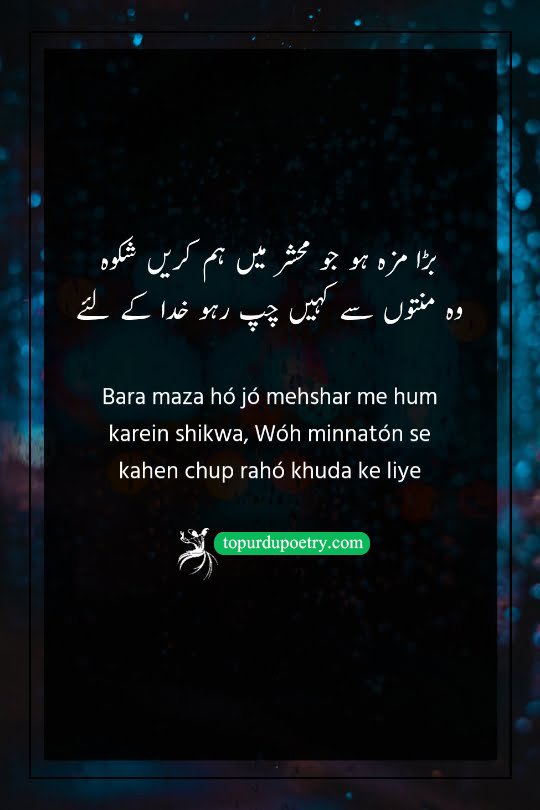
بڑا مزہ ہو جو محشر میں ہم کریں شکوہ وہ منتوں سے کہیں چپ رہو خدا کے لئے
Bara maza ho jo mehshar mein hum karein shikwa Woh minnaton se kahein chup raho khuda ke liye
In this witty and sharp bewafa poetry in Urdu, the poet imagines a grand scene on the Day of Judgment (Mehshar). Instead of seeking salvation, he looks forward to the chance to finally voice his grievances against his unfaithful beloved. The beauty of the poem lies in the reversal of power; the beloved, who once ignored the lover's pain, is now reduced to begging for silence to save their reputation.
گزرے ہیں آج عشق میں ہم اس مقام سے نفرت سی ہو گئی ہے محبت کے نام سے
Guzre hain aaj ishq mein hum us maqaam se Nafrat si ho gayi hai محبت کے نام سے
In this powerful verse by Sahir Ludhianvi, the poet describes reaching a state of total emotional burnout. After enduring the trials and betrayals of love, he reaches a 'maqaam' (stage) where his grief transforms into a deep-seated resentment. He no longer finds beauty in romance; instead, the very word 'Muhabbat' now evokes a sense of 'Nafrat' (hatred). It is the final, cold destination of a heart that has been burned so many times that even the word 'love' now feels like a hollow echo of a broken promise.
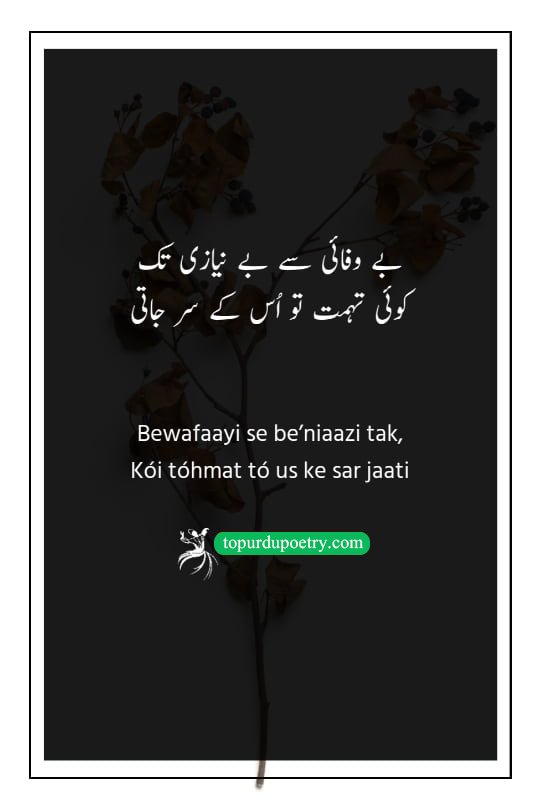
بے وفائی سے بے نیازی تک کوئی تہمت تو اُس کے سر جاتی
Bewafaayi se be’niaazi tak Koi tohmat to us ke sar jaati
In this profound bewafa shayari Urdu, the poet describes the ultimate insult in a relationship: indifference. He notes that while being betrayed (Bewafaayi) is painful, it still acknowledges your presence. However, when a beloved moves toward 'Be-niaazi' (indifference), they become untouchable and beyond blame. The poet laments that he can’t even accuse them of a crime because they have become so detached that even a 'Tohmat' (blame) feels like too much of a connection. It is the chilling realization that being forgotten is far worse than being hurt.
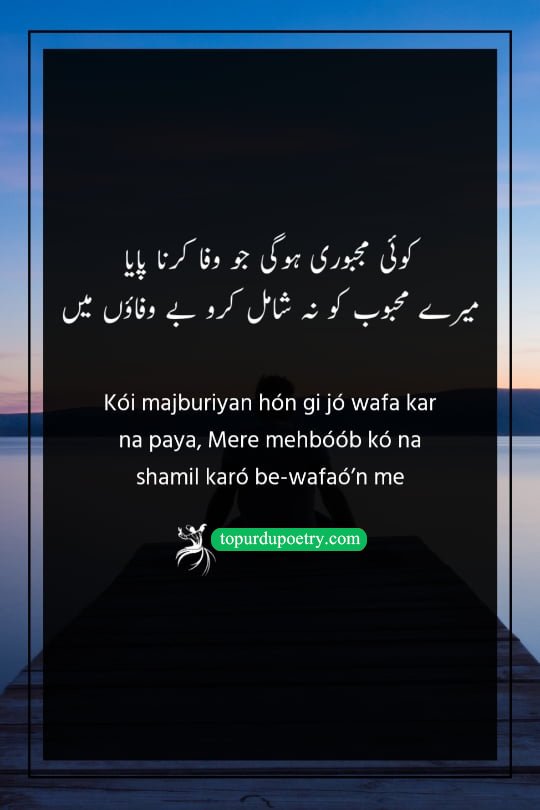
کوئی مجبوری ہوگی جو وفا کرنا پایا میرے محبوب کو نہ شامل کرو بے وفاؤں میں
Koi majburiyan hon gi jo wafa kar na paya Mere mehboob ko na shamil karo be-wafaon mein
In this deeply emotional and forgiving bewafai Urdu poetry, the poet chooses to see the world through the lens of unconditional love. Rather than accepting the pain of betrayal, he attributes the beloved's departure to 'Majboori' (compulsion), making excuses for their absence. It is a powerful depiction of a heart that values the dignity of the beloved more than its own suffering. Even in the silence of a broken promise, the lover stands as a protector, refusing to let the world label his beloved as unfaithful. It is a beautiful and tragic reminder that true love often finds reasons to forgive what the rest of the world calls betrayal.
رسوائیوں کو آپ کو آیا ہے اب خیال ہم نے تو اپنے دوست بھی دشمن بنا لیے
Ruswaayiyon ka aap ko aaya hai ab khayaal Hum ne to apne dost bhi dushman bana liye
In this sharp and bitter bewafa poetry, the poet addresses the hypocrisy of a beloved who suddenly fears public disgrace. He points out the tragic irony that while the beloved is now trying to save face, the lover has already lost everything—even turning their own friends into enemies for the sake of this love. It is a powerful statement on the total isolation that follows a deep, sacrificial devotion. It serves as a cold reminder that once you have sacrificed your world for someone, their sudden 'caution' feels less like a gesture of care and more like a final betrayal of your shared history.
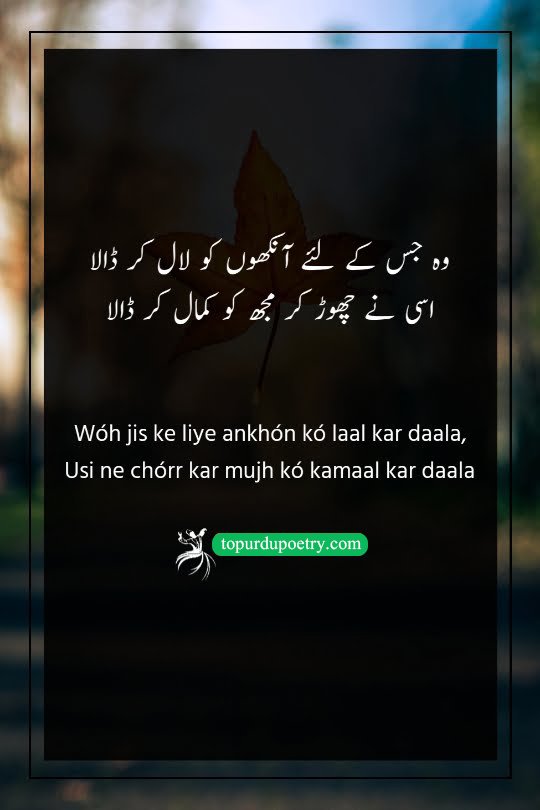
وہ جس کے لئے آنکھوں کو لال کر ڈالا اسی نے چھوڑ کر مجھ کو کمال کر ڈالا
Woh jis ke liye aankhon ko laal kar daala Usi ne chorr kar mujh ko kamaal kar daala
In this bitterly sarcastic verse, the poet reflects on the ultimate irony of a one-sided devotion. He describes the physical and emotional exhaustion of a lover who has wept until their eyes turned red, only to be met with total abandonment. The use of the word 'Kamaal' (extraordinary) highlights the shock of the betrayal—suggesting that leaving someone who gave their all is a feat of coldness that only a truly unfaithful heart could achieve. It is a powerful expression of the moment when a person realizes that their greatest sacrifices were met with a calculated exit, leaving behind nothing but a haunting silence.
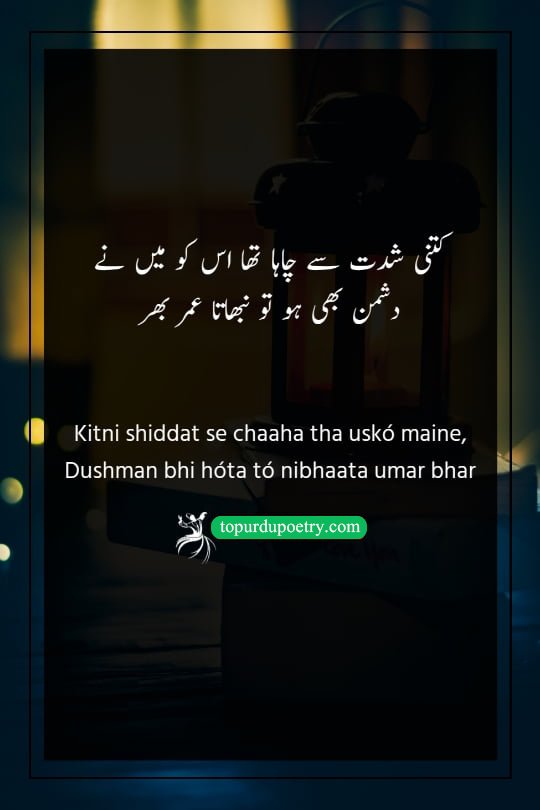
کتنی شدت سے چاہا تھا اس کو میں نے دشمن بھی ہو تو نبھاتا عمر بھر
Kitni shiddat se chaaha tha usko maine Dushman bhi hota to nibhaata umar bhar
In this heart-wrenching verse, the poet explores the irony of a love that was too heavy for the beloved to carry. He suggests that his devotion was so 'shiddat-pasand' (intense) that it commanded a certain level of respect and constancy. The tragedy lies in the fact that while an enemy might have felt compelled to stay out of respect for such passion, the beloved chose to walk away with ease. It is a haunting acknowledgment that sometimes, an enemy’s constant presence is more reliable than a beloved’s fleeting promise.
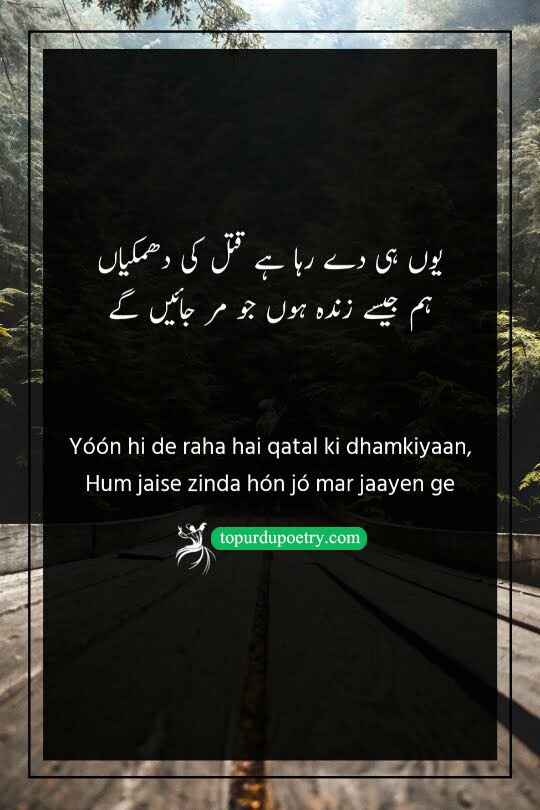
یوں ہی دے رہا ہے قتل کی دھمکیاں ہم جیسے زندہ ہوں جو مر جائیں گے
Yoon hi de raha hai qatal ki dhamkiyaan Hum jaise zinda hon jo mar jaayen ge
In this sharp and defiant verse, the poet responds to the threat of further pain with a chilling sense of irony. He argues that 'Qatal' (murder) or death can only affect those who still possess a spark of life or hope. By claiming that he is already dead inside from a lifetime of betrayals, he turns the threat of death into a meaningless gesture. It is a powerful exploration of existential numbness—where a heart has been broken so many times that the fear of the end has completely vanished, leaving behind a soul that is untouchable by any further cruelty.
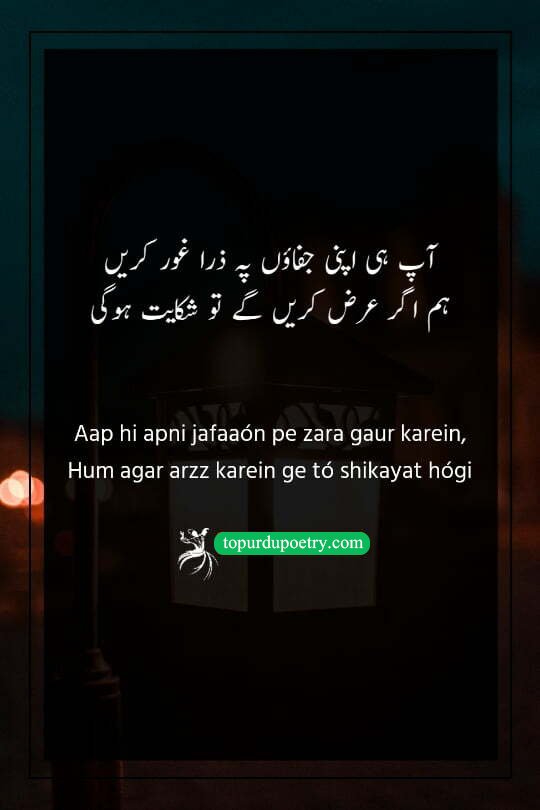
آپ ہی اپنی جفاؤں پہ ذرا غور کریں ہم اگر عرض کریں گے تو شکایت ہوگی
Aap hi apni jafaaon pe zara gaur karein Hum agar arzz karein ge to shikayat hogi
In this brilliantly balanced bewafa poetry in Urdu, the poet explores the delicate boundaries of silence and speech in a relationship. He points out the tragic irony where a victim's attempt to speak the truth is dismissed as mere 'shikayat' (complaining). By asking the beloved to judge their own 'jafa' (cruelty), the poet highlights a betrayal so clear that it requires no external proof. It is a powerful reflection on the exhaustion of being hurt and then being blamed for hurting—a reminder that sometimes, the most cutting truth is the one we refuse to say out loud.
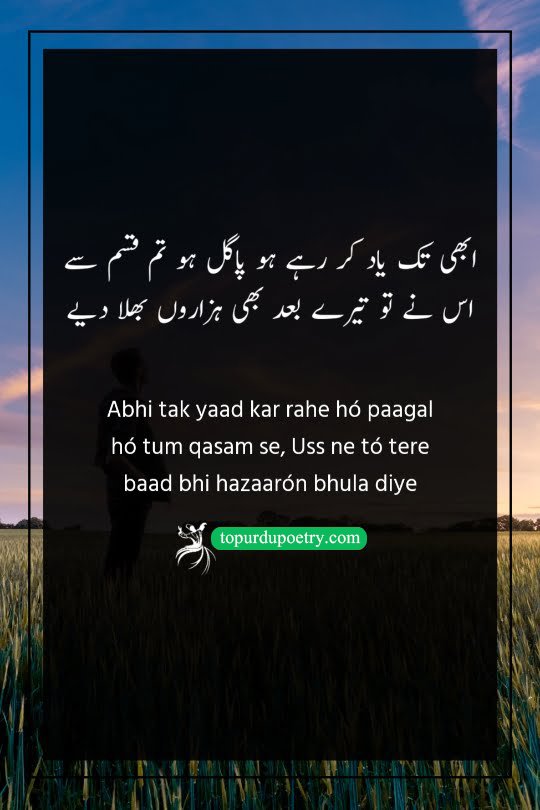
ابھی تک یاد کر رہے ہو پاگل ہو تم قسم سے اس نے تو تیرے بعد بھی ہزاروں بھلا دیے
Abhi tak yaad kar rahe ho paagal ho tum qasam se Uss ne to tere baad bhi hazaaron bhula diye
In this strikingly blunt bewafa dost poetry, the poet confronts the absurdity of a one-sided obsession. It serves as a harsh awakening for a heart that refuses to let go, labeling such loyalty as a form of madness. The tragedy is amplified by the realization that while the lover is busy preserving a memory, the beloved has already moved through a thousand other lives and forgotten them all. It is a powerful reflection on the insignificance of one's own pain in the face of a truly indifferent and unfaithful heart—a reminder that some people are experts at erasing the past while you are still trying to read it.
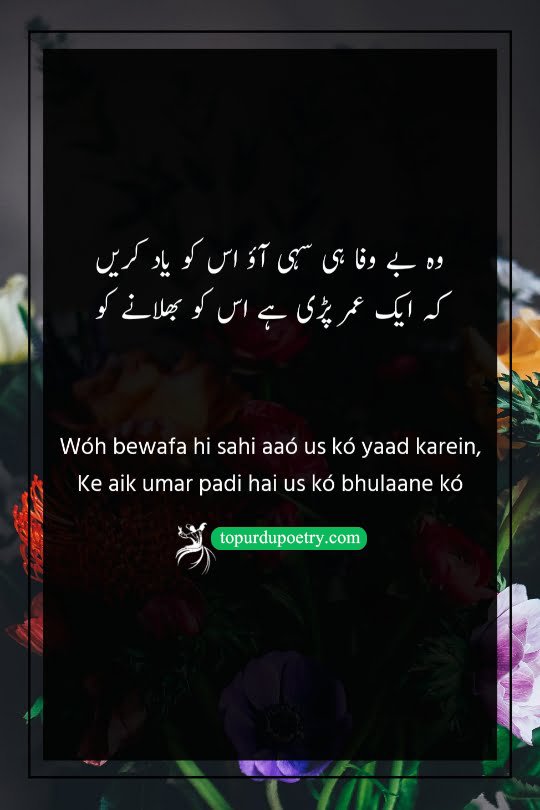
وہ بے وفا ہی سہی آؤ اس کو یاد کریں کہ ایک عمر پڑی ہے اس کو بھلانے کو
Wóh bewafa hi sahi aaó us kó yaad karein Ke aik umar padi hai us kó bhulaane kó
In this deeply moving verse, the poet explores the complex relationship between memory and betrayal. He suggests that while the beloved may have been unfaithful, the impact they had on one's life cannot be erased instantly. Instead of forcing himself to forget, the poet decides to sit with the memories, acknowledging that the process of truly moving on is a journey that lasts a lifetime. It is a soulful reflection for anyone who understands that 'bhulana' (forgetting) is not an act of will, but a slow erosion of the heart over time. It honors the love that was, even if the ending was bitter.
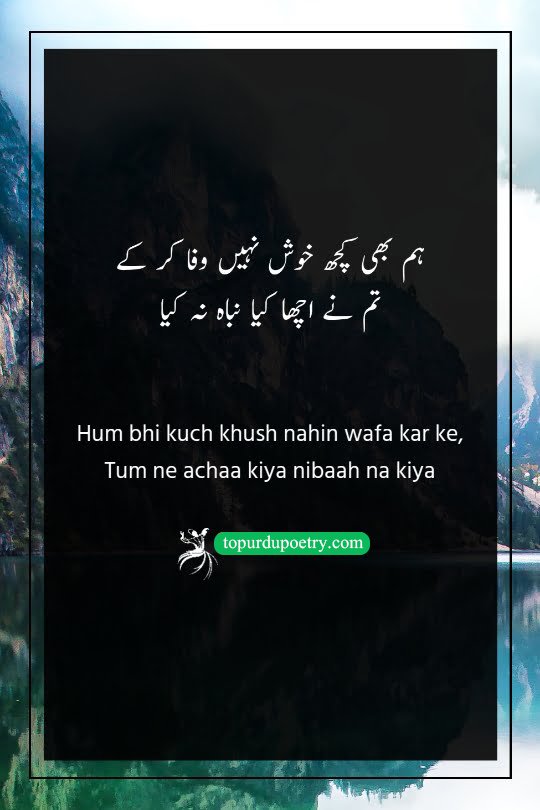
ہم بھی کچھ خوش نہیں وفا کر کے تم نے اچھا کیا نباہ نہ کیا
Hum bhi kuch khush nahin wafa kar ke Tum ne achaa kiya nibaah na kiya
In this strikingly cynical and weary bewafa shayari Urdu, the poet flips the traditional narrative of heartbreak. Instead of mourning the beloved’s unfaithfulness, he admits that his own loyalty ('wafa') brought him no joy or peace. By telling the beloved 'you did well by not staying,' he suggests that an honest betrayal is often more merciful than a forced, miserable connection. It is the cold realization of a heart so exhausted by the burden of its own devotion that it finally finds a strange relief in being abandoned—proving that sometimes, being 'left' is the only way to be 'free'.
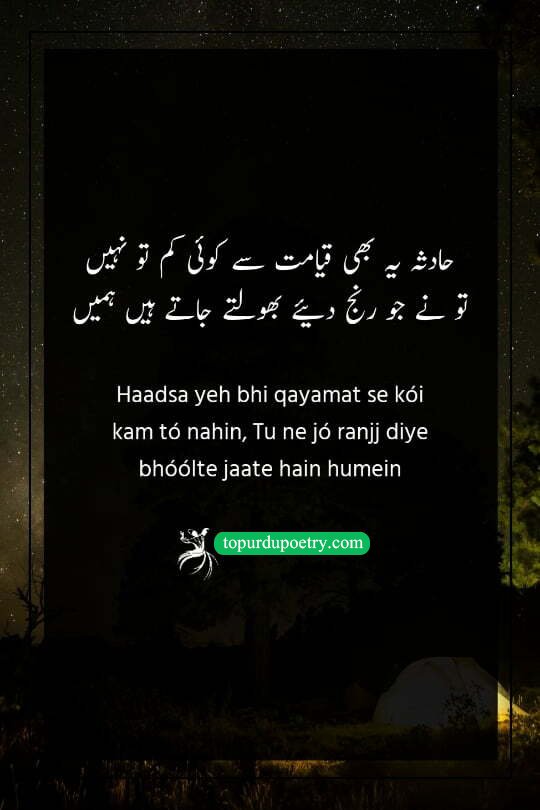
حادثہ یہ بھی قیامت سے کوئی کم تو نہیں تو نے جو رنج دئیے بھولتے جاتے ہیں ہمیں
Haadsa yeh bhi qayamat se koi kam to nahin Tu ne jo ranjj diye bhoolte jaate hain humein
In this deeply paradoxical and haunting bewafa shayari urdu, the poet describes a tragedy that feels like the end of the world: the fading of his own pain. Usually, forgetting the betrayal of a beloved is considered a relief, but for a true lover, the sorrows given by them are the last treasures of a lost history. As the 'Ranj' (grief) begins to disappear, so does the last remaining connection to the person who caused it. It is a chilling realization that once the heart stops hurting, the beloved truly becomes a stranger, making the loss of sorrow the most final and devastating heartbreak of all.
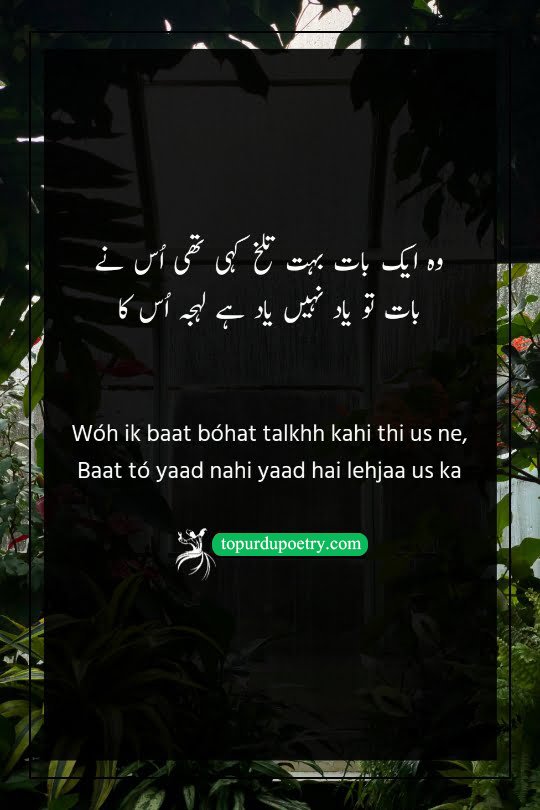
وہ ایک بات بہت تلخ کہی تھی اُس نے بات تو یاد نہیں یاد ہے لہجہ اُس کا
Woh ik baat bohat talkh kahi thi us ne Baat toh yaad nahi yaad hai lehja us ka
In this strikingly accurate verse, the poet explores the lasting impact of a harsh encounter. He notes that while time eventually erases the specific words spoken during a betrayal, it can never wash away the 'Lehja' (tone) in which they were delivered. It is a powerful reflection on emotional trauma—suggesting that the pain of a heartbreak isn't always in the facts, but in the coldness and bitterness of the person who walked away. It serves as a reminder that people may forget your words, but they will always remember the way you made them feel during your final goodbye.
Reflecting on Loss with Bewafa Log Poetry
There is a specific kind of sadness that comes from realizing that people change. Exploring bewafa log poetry helps us understand that while people may leave, the strength we find within ourselves remains. These verses focus on the reality of shifting loyalties and the strength required to stand alone after being let down. If you are searching for bewafa quotes in Urdu to help you process your thoughts, you will find that these lines of (بےوفا شاعری) resonate with the truth of your experience.
میں تو اس کو دیکھتے ہی جیسے پتھر ہوگیا بات تک نہ منہ سے نکلی بے وفا کے سامنے
Mein tou usko dekhtay hi jaisy pathar ho gaya Baat tak na munh se nikli be-wafa k saamney
In this striking couplet, the poet captures the moment of absolute shock that occurs when one finally comes face-to-face with a betrayer. He describes the physical sensation of becoming 'Pathar' (stone)—a state of paralysis where the heart's anger and the mind's grievances are frozen by the sheer sight of the 'Bewafa.' It is a poignant reflection on the irony of silence; despite having a world of complaints to share, the poet finds himself unable to utter a single word. It proves that some betrayals are so profound that they don't just break the heart—they silence the soul.
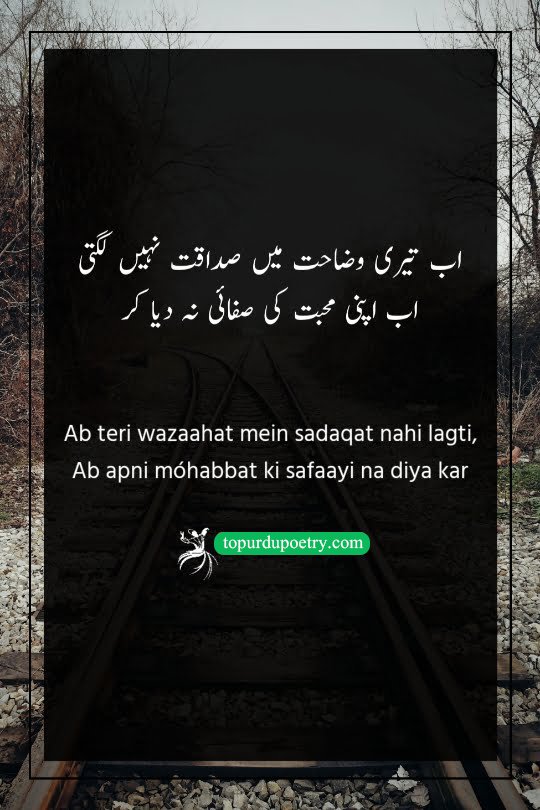
اب تیری وضاحت میں صداقت نہیں لگتی اب اپنی محبت کی صفائی نہ دیا کر
Ab teri wazaahat mein sadaqat nahi lagti Ab apni mohabbat ki safaayi na diya kar
In this firm and weary verse about bewafa log poetry, the poet describes the death of trust. He points out that once a person has been betrayed, even the most logical 'Wazaahat' (explanation) feels like a lie. By asking the beloved to stop giving 'Safaayi' (justification) for their love, the poet is reclaiming his peace. It is a powerful reflection on the 'Point of No Return' in a relationship—where words lose their power, and the silence of a broken heart becomes louder than any excuse. It is the ultimate boundary-setting poem for those who are tired of hearing 'I'm sorry' without any change in action.
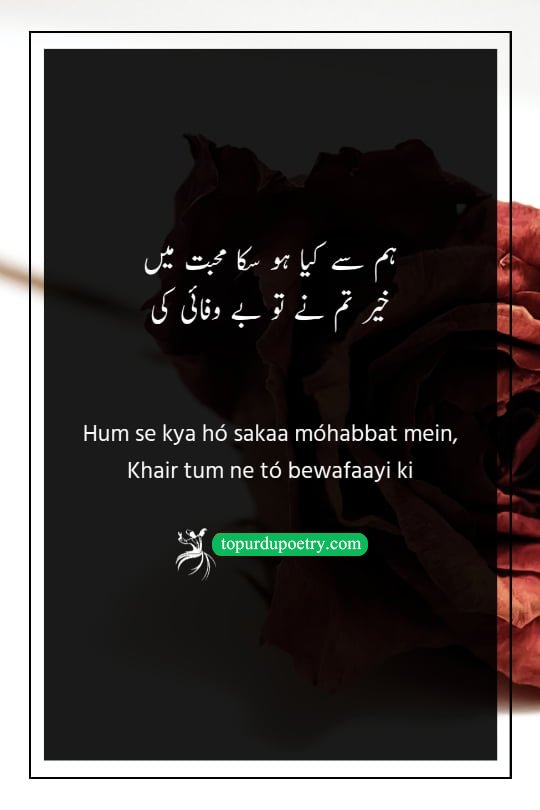
ہم سے کیا ہو سکا محبت میں خیر تم نے تو بے وفائی کی
Hum se kya ho sakaa mohabbat mein Khair tum ne to bewafaayi ki
In this subtly sarcastic and weary bewafa mard poetry, the poet reflects on a failed romance with a sense of bitter irony. He starts by admitting his own inadequacy—feeling that he couldn't 'win' at love or keep it alive. However, he quickly turns the focus to the beloved, 'congratulating' them for at least doing something decisive: being unfaithful. It is a powerful depiction of a relationship where one person feels like a failure for losing, while the other is exposed as a villain for betraying. It captures the cold reality that sometimes, the only thing 'achieved' in a relationship is the pain of walking away.
ساری زندگی جو رکھا رشتوں کا بھرم کوئی اپنے سوا مگر اپنا نہیں ہوتا
Sari zindagi jo rakha rishton ka bharam Koi apne siwa magar apna nahi hota
In this deeply moving and realistic bewafa quotes in Urdu, the poet reflects on the heavy cost of maintaining social and family ties. He describes a life spent protecting the 'Bharam' (sanctity/illusion) of relationships, only to realize that such efforts are often one-sided. It captures the painful awakening that occurs when a person realizes that despite their sacrifices for others, the only person who truly stays by their side through everything is themselves. It is a powerful anthem for self-reliance and a warning against losing one's identity in the pursuit of keeping others happy.
وہ شخص بھی میرے حال سے انجان بیٹھا ہے یوں عشق میں گویا ہم نے پایا کچھ بھی نہیں
Woh shakhsh bhi mere haal se anjaan betha hai Yoon ishq mein goya hum ne paaya kuch bhi nahin
In this hauntingly realistic bewafa poetry in Urdu, the poet reflects on the absolute failure of his devotion. He describes the crushing realization that the very person who is the center of his universe remains 'Anjaan' (unaware) of his suffering. It captures the moment of total disillusionment where the 'Ghazal' of love ends in a zero—proving that if your pain isn't even recognized by the one you love, the entire struggle of your heart was for nothing. It is a profound anthem for those who have loved deeply only to find themselves standing in a desert of indifference.
گیلا کاغذ کی طرح زیست ہماری ٹھری کوئی لکھتا بھی نہیں کوئی جالاتا بھی نہیں
Geela kaghaz ki tarha zeest hamari thehri Koi likhta bhi nahi, koi jalata bhi nahi
In this strikingly original bewafa shayari Urdu, the poet compares his life to a 'Geela Kaghaz' (wet paper)—a powerful metaphor for total stagnation. A wet paper is fundamentally useless; it is too soft to be written upon and too damp to be consumed by fire. It captures the agonizing feeling of being ignored by the world. The poet laments that he is denied both a purpose (love/story) and an end (destruction/peace). It is a profound anthem for those who feel like they are existing in a state of 'Be-niaazi' (indifference), where they are neither valued nor even deemed worthy of being hated.
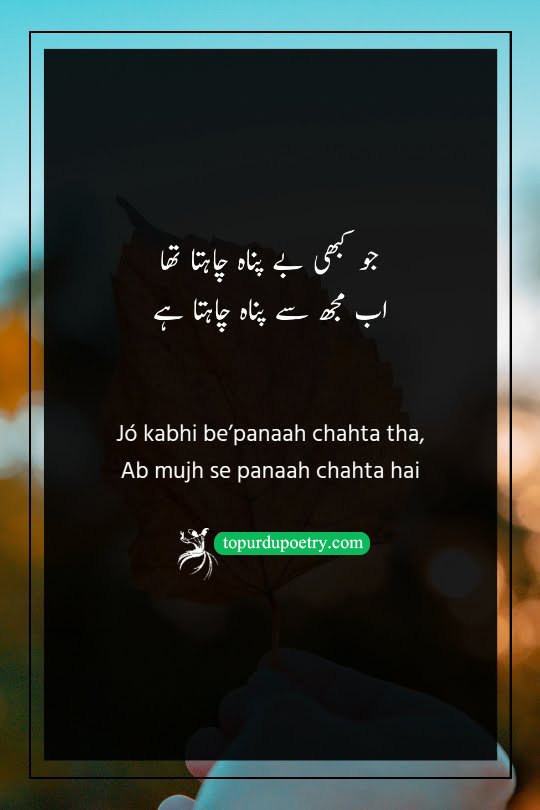
Jo kabhi be-panaah chahta tha Ab mujh se panaah chahta hai
This bewafai Urdu poetry is a masterclass in emotional irony. It captures the painful reversal of roles in a failing relationship. The poet reflects on a time when the beloved's love was 'be-panaah' (limitless), only to be met with a present where that same person seeks 'panaah' (refuge) from them. It describes the moment a lover realizes they have transformed from a person’s world into their greatest fear or burden. It is the ultimate expression of how yesterday's obsession can become today's avoidance.
یہ جو ہم چپ چاپ ہیں تو اس کو بھی غنیمت جانو ہم اگر صبر نہ کرتے تو قیامت کرتے
Yeh jo hum chup hain to is ko bhi ghaneemat jano Hum agar sabar na karte to qayamaat karte
In this powerful and defiant bewafa poetry in urdu 2 lines:, the poet redefines silence not as a sign of weakness, but as a conscious act of mercy. He warns the one who hurt him that his 'Sabar' (patience) is the only thing standing between them and a total social or emotional 'Qayamat' (catastrophe). It captures the moment a person realizes they hold enough truth to destroy the one who betrayed them, yet they choose the dignity of silence. It is an anthem for the strong-willed who prefer to walk away with their secrets rather than stoop to the level of their enemies.
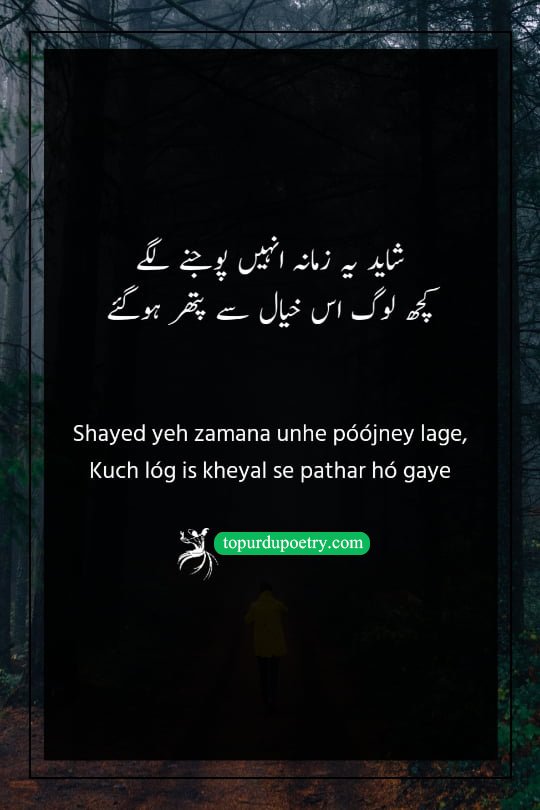
شاید یہ زمانہ انہیں پوجنے لگے کچھ لوگ اس خیال سے پتھر ہوگئے
Shayed yeh zamana unhe poojney lage Kuch log is kheyal se pathar ho gaye
In this deeply philosophical verse on bewafa log poetry, the poet exposes the vanity behind a 'stone-hearted' personality. He suggests that some people deliberately discard their emotions and warmth, choosing to become 'pathar' (stone) in the hope that the world will worship them as idols. It is a chilling reflection on how the pursuit of status and ego can lead to the death of the heart. Instead of being victims of fate, these individuals are victims of their own desire to be put on a pedestal, proving that the cost of being 'worshipped' is often the loss of one's own humanity.
کوئی سوال جو پوچھے تو کیا کہوں اُس سے بچھڑنے والے سبب تو بتا جدائی کا
Koi sawaal jo poochay to kia kahoon us se Bicherney walay Sabab to bata judai ka
In this heart-wrenching verse, the poet explores the agony of being left without closure. He addresses the beloved who is walking away, pleading for just one thing: a reason ('Sabab') for the separation. The tragedy here is two-fold; not only is the lover losing their partner, but they are also being left without an answer to give the world. It captures that haunting feeling of being abandoned in a 'Sawaal' (question) that has no end. It is a powerful reflection on how a lack of explanation can be more damaging than the breakup itself.
مفت میں احسان نہ لینا محسن دل ابھی اور بھی سستے ہوں گے
Muft mein ehsaan na lena mohsin Dil abhi aur bhi saste hon ge
In this bitingly cynical bewafa quotes in Urdu, the poet reflects on the diminishing value of sincerity and love in the modern world. He cautions against accepting favors ('Ehsaan') from others, suggesting that the cost of such obligations is too high for something as devalued as a human heart. By predicting that 'Dil' (hearts) will become even 'Saste' (cheaper) in the future, he paints a portrait of a society where emotions are traded like low-cost goods. It is a powerful warning for those who still value their own worth in an increasingly heartless and transactional world.
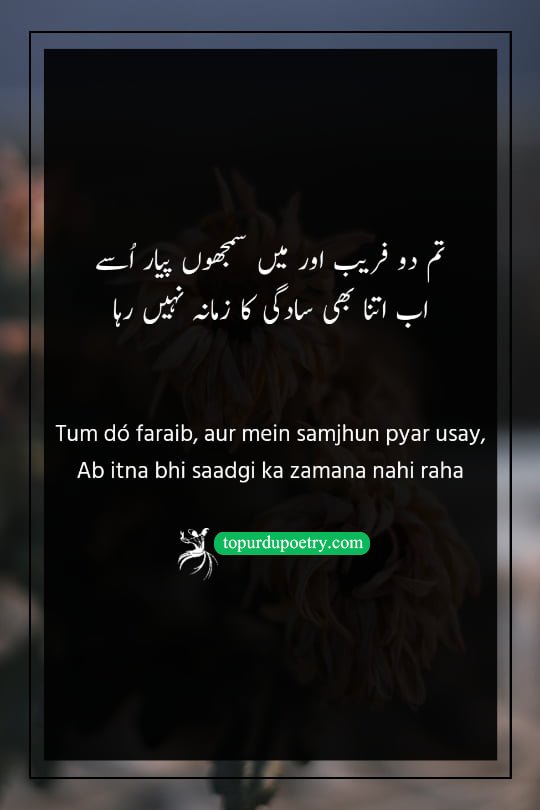
تم دو فریب اور میں سمجھوں پیار اُسے اب اتنا بھی سادگی کا زمانہ نہیں رہا
Tum do faraib, aur mein samjhun pyar usay Ab itna bhi saadgi ka zamana nahi raha
In this strikingly modern and defiant bewafa poetry in urdu text, the poet announces the death of his own naivety. He directly confronts a beloved who uses 'faraib' (deception) under the guise of 'pyar' (love), informing them that those days are over. By stating that the 'Zamana' (era) of 'Saadgi' (simplicity) has passed, the poet reclaims his dignity and logic. It is a powerful anthem for anyone who has decided to stop being 'fooled' by empty promises and has finally learned to distinguish between true devotion and calculated manipulation.
Sirf hum hain un ke dil mein Le doobi yeh ghalat fehmi hum ko
In this painfully honest verse, the poet reflects on the danger of one-sided expectations. He describes the moment of awakening when a lover realizes that their sense of being 'special' was merely a self-created illusion. By using the phrase 'Le doobi' (drowned us), the poet highlights that false hope is often more destructive than the truth itself. It is a powerful warning for the heart: believing you are the 'only one' without proof is a misunderstanding that can lead to total emotional ruin. It captures the silent, drowning feeling of realizing you were never even in the race you thought you were winning.
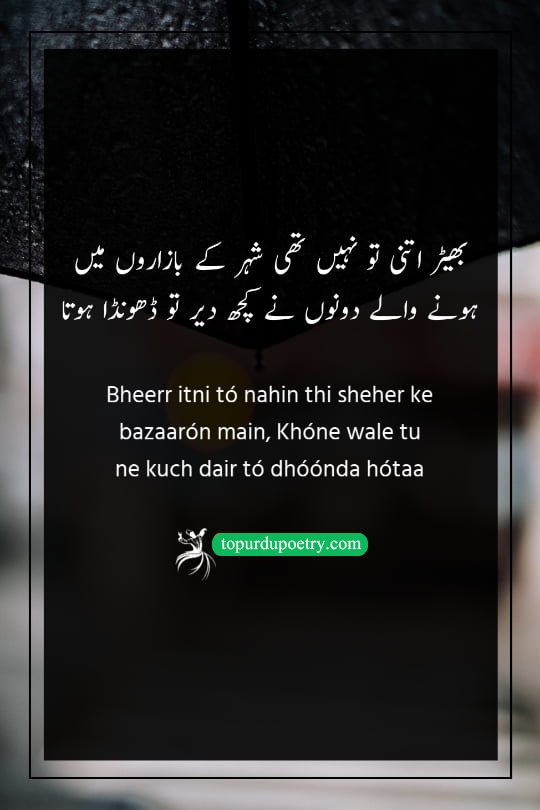
بھیڑ اتنی تو نہیں تھی شہر کے بازاروں میں کھونے والے تو نے کچھ دیر تو ڈھونڈا ہوتا
Bheerr itni toh nahin thi sheher ke bazaaron mein, Khone wale tu ne kuch dair toh dhoonda hota
In this deeply moving verse, the poet confronts the painful reality of being 'let go' rather than 'lost.' By using the metaphor of a city market, he argues that the world is never too busy or too crowded for those who truly care to find each other. The heartbreak lies in the realization that the beloved didn't even attempt a search. It is a powerful reflection on the difference between a forced separation and an intentional abandonment—a reminder that we only truly lose what we stop looking for.
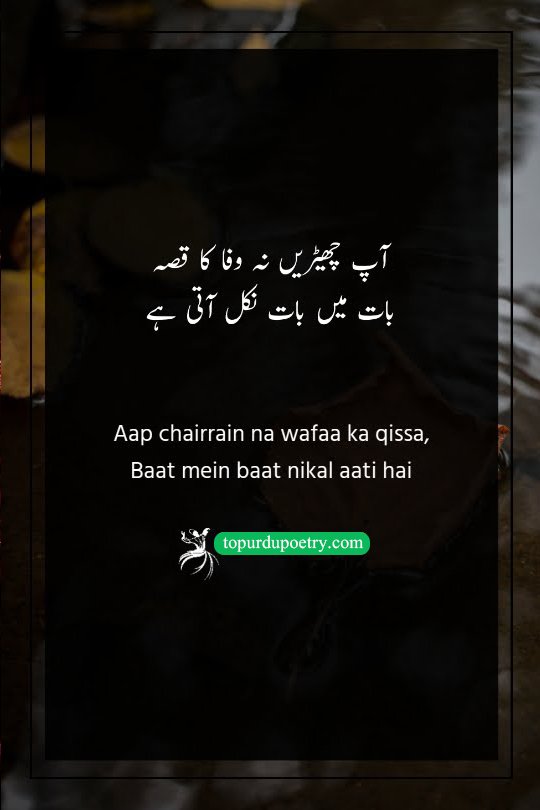
Aap chairrain na wafaa ka qissa Baat mein baat nikal aati hai
In this brilliantly cautious verse, the poet warns against discussing loyalty in a relationship that has been marred by betrayal. He points out that once the topic of 'Wafa' (faithfulness) is introduced, it inevitably leads to a chain reaction of 'Shikayat' (complaints) and the uncovering of painful truths. It is a powerful reflection on the precaution of silence—the idea that some topics are better left untouched to maintain a fragile peace. It suggests that the poet is staying silent not because they have forgotten, but because they are choosing to protect the other person from the harsh reality of their own actions.
The Depth of Emotion in Bewafa Poetry
The beauty of Urdu literature is how it turns even the most painful betrayal into art. Our collection of bewafa poetry in Urdu covers everything from the initial shock of being let go to the long, lonely nights of missing someone who wasn’t true. By reading through these bewafai Urdu poetry or (بےوفا شاعری), you can find the perfect words to describe the “bewafai” (infidelity) that has touched your life.
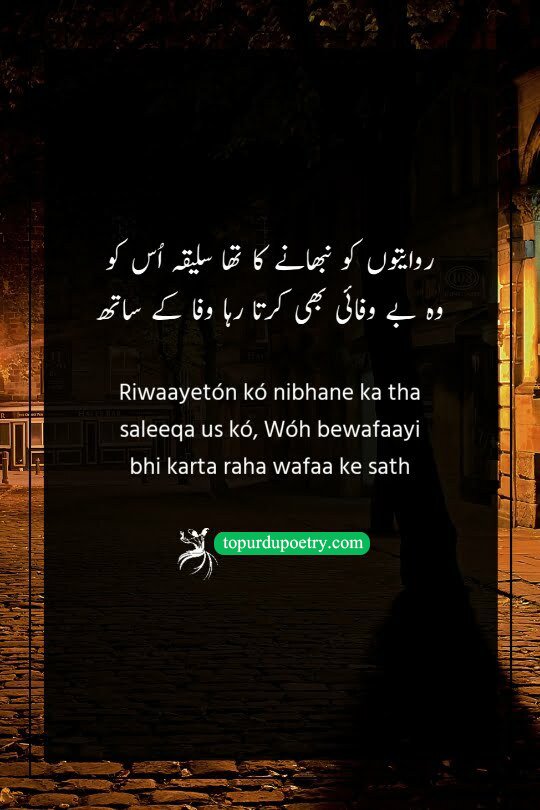
روایتوں کو نبھانے کا تھا سلیقہ اُس کو وہ بے وفائی بھی کرتا رہا وفا کے ساتھ
Riwaayetón kó nibhane ka tha saleeqa us kó Wóh bewafaayi bhi karta raha wafaa ke sath
In this cutting bewafai Urdu poetry, the poet explores the irony of a 'civilized' betrayal. It depicts a person who is so well-versed in social etiquette ('saleeqa') that they manage to balance loyalty and unfaithfulness with disturbing ease. By keeping up the 'Riwaayet' (tradition) of a relationship, they hide their true character, proving that an honest enemy is often better than a polite hypocrite. It is a powerful reflection on the type of betrayal that feels like a 'ritual'—where the manners are perfect, but the heart is absent.
In this hauntingly beautiful bewafa poetry in Urdu, the poet draws a parallel between the purity of childhood and the rarity of true loyalty. He observes that in the modern world, finding a person who is truly 'Wafa-daar' (loyal) is as difficult as finding a child who is capable of sin. By comparing the absence of faith in adults to the absence of guilt in children, the poet highlights a tragic societal shift: where sincerity used to be a natural human trait, it has now become an exception. It is a perfect reflection for those who value the simplicity of the heart over the complexities of worldly betrayal.
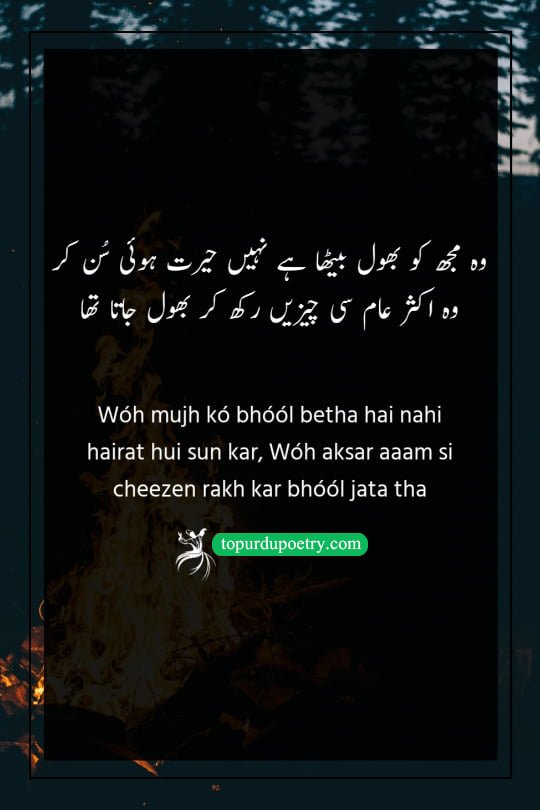
وہ مجھ کو بھول بیٹھا ہے نہیں حیرت ہوئی سُن کر وہ اکثر عام سی چیزیں رکھ کر بھول جاتا تھا
Woh mujh ko bhool betha hai nahi hairat hui sun kar Woh aksar aaam si cheezen rakh kar bhool jata tha
In this brilliantly self-deprecating bewafa poetry in english , the poet explores the pain of being 'ordinary.' Instead of blaming the beloved for being unfaithful, the poet blames their own lack of significance. By comparing themselves to a common household object that is easily misplaced and forgotten, the poet captures the crushing realization that they were never a priority. It is a powerful reflection on the 'Be-niaazi' (indifference) of a lover who treats a human heart like a spare key or a misplaced trinket—something that is only missed when it is gone, and even then, not for long.
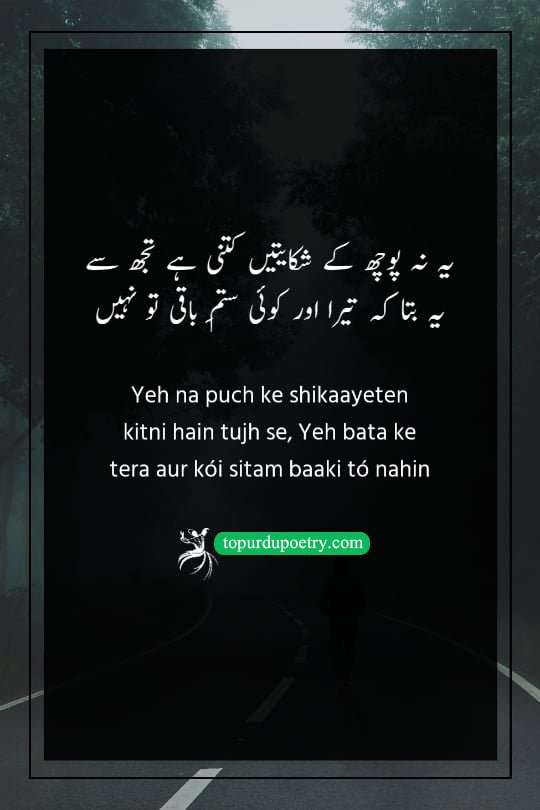
یہ نہ پوچھ کے شکایتیں کتنی ہے تجھ سے یہ بتا کہ تیرا اور کوئی سِتم باقی تو نہیں
Yeh na puch ke shikaayeten kitni hain tujh se Yeh bata ke tera aur koi sitam baaki toh nahin
In this weary and defiant bewafa shayari Urdu, the poet describes the 'saturation point' of a heartbreak. He refuses to list his 'Shikaayeten' (complaints), suggesting that the betrayal is now too vast for words. Instead, he asks the beloved if there is any 'Sitam' (cruelty) left in their arsenal. It captures the spirit of someone who has endured so much pain that they are no longer afraid of it. It is a powerful anthem for the resilient soul—one that has moved past the stage of crying and into the stage of cold, hard endurance.
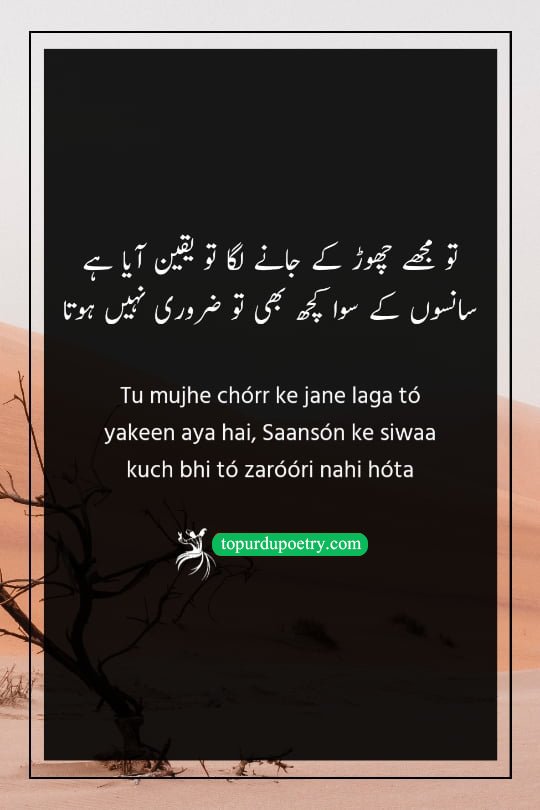
تو مجھے چھوڑ کے جانے لگا تو یقین آیا ہے سانسوں کے سوا کچھ بھی تو ضروری نہیں ہوتا
Tu mujhe chorr ke jane laga to yakeen aya hai Saanson ke siwaa kuch bhi to zaroori nahi hota
In this hauntingly realistic verse, the poet explores the 'Survival Instinct' that kicks in after a major heartbreak. It describes the moment of clarity that comes when a person is abandoned: the realization that the beloved was not, in fact, their life-source. By stating that 'nothing except breath is essential,' the poet strips away the drama of romance and settles for the cold truth of existence. It is a powerful anthem for anyone who has survived a 'world-ending' breakup and realized that as long as they are still breathing, they are still standing. It is the ultimate reflection on the resilience of the human spirit.
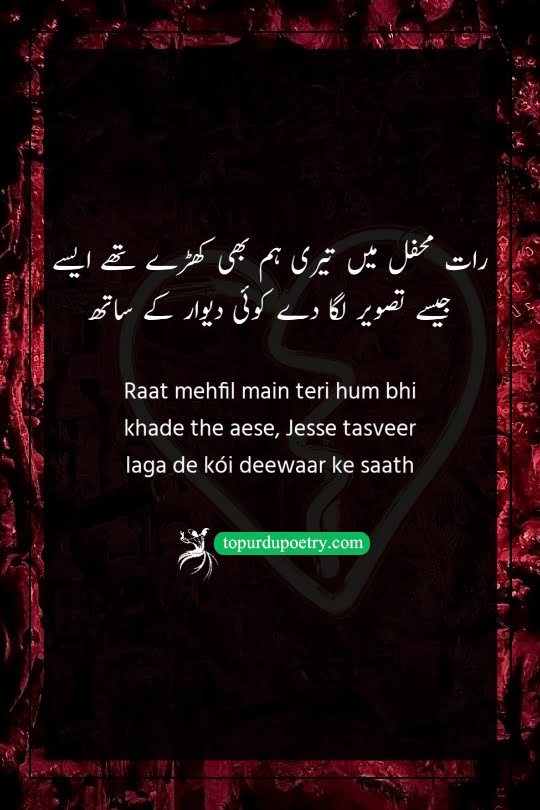
رات محفل میں تیری ہم بھی کھڑے تھے ایسے جیسے تصویر لگا دے کوئی دیوار کے ساتھ
Raat mehfil main teri hum bhi khade the aese Jesse tasveer laga de koi deewaar ke saath
In this hauntingly still verse, the poet explores the tragedy of being ignored while in plain sight. He describes his presence in the beloved's gathering not as a guest or a lover, but as a 'Tasveer' (picture) hung against a wall. It captures the chilling feeling of becoming a background object in the life of someone you once shared everything with. It is a powerful reflection on the loneliness that exists even in a crowded room—the realization that you have been stripped of your voice and relegated to a mere silent witness of your own heartbreak.
افسوس ٹھیک سہی تیرے بدل جانے کا تیری باتوں نے مگر جینا سکھایا ہے
Afsos theek sahi tere badal jaane ka Teri baaton ne magar jeena sikhaya hai
In this empowering and mature bewafa quotes in Urdu, the poet transforms a tragedy into a life lesson. While admitting the deep sorrow of seeing a beloved change, he credits that very experience for his survival. It suggests that the 'Baatein' (words/experiences) of a betrayal are often the hardest teachers, but they are the ones that finally teach a person how to truly navigate life's challenges. It is a powerful anthem for anyone who has found their strength in the middle of a heartbreak—proving that while the person left, the wisdom they inadvertently gave you stays forever.
گلہ بنتا ہی نہیں ان سے بے رخی کا دل ہی تو تھا بھر گیا ہوگا
Gila banta hi nahi un se berukhi ka Dil hi toh tha, bhar gaya hoga
In this weary and cynical bewafa poetry in urdu, the poet moves past the stage of 'Shikwa' (complaint) and into the stage of absolute resignation. Instead of calling the beloved a 'Bewafa' (traitor), the poet offers a simpler, more painful excuse: human nature. By suggesting that 'Dil hi toh tha' (it was just a heart), the poet implies that emotions are temporary and that it is only natural for someone to eventually lose interest. It is a powerful reflection on the 'Disposable' nature of modern love—capturing the moment someone realizes they were just a phase in someone else's life.
پاگل پن کی ساری لکیریں میرے ہاتھ میں کیوں جس کو چاہوں میں ہی چاہوں میں ہی چاہوں کیوں
Pagalpan ki sari lakeerein mere hath me kyun Jis ko chahoon me hi chahoon, mei hi chahoon kyun
In this intensely emotional and questioning verse, the poet confronts the unfairness of destiny. Using the metaphor of palmistry ('Lakeerein'), he laments that he was born with a heart destined for 'Pagalpan' (madness/obsession). It captures the painful exhaustion of asymmetrical love—where one person gives their entire soul while the other remains indifferent. It is a powerful anthem for those who feel cursed by their own depth, asking the universe why they are always the ones to love more, give more, and hurt more in a world of shallow connections.
ہم تجھے بھول کے خوش بیٹھے ہیں ہم سا بے درد کوئی کیا ہوگا؟
Hum tujhe bhool ke khush baithe hain Hum sa be-dard koi kia ho ga
In this bitingly ironic bewafa poetry in Urdu, the poet explores the guilt of moving on. Instead of blaming a 'Bewafa' (unfaithful) lover, the poet turns the lens on themselves, claiming to be 'happy' after forgetting the past. By labeling themselves as 'Be-dard' (heartless), the poet highlights the unnatural feeling of peace that follows a long period of grief. It is a powerful reflection for anyone who has finally found happiness after a breakup, only to realize that their new-found strength feels like a cold, hard shield. It captures the moment when survival feels like a betrayal of the heart's original devotion.
Heartbreaking Bewafa Dost Poetry in Urdu
While romantic heartbreak is common, the sting of a loyal friend turning away is a unique kind of sorrow. Exploring bewafa dost poetry in Urdu allows you to express that specific feeling of being let down by someone you considered a brother or sister. These verses about (بےوفا شاعری) focus on the shattered trust and the realization that not everyone who walks with you is truly on your side. If you have experienced a friendship that ended in betrayal, sharing these couplets of Urdu poetry for bewafa dost can be a powerful way to voice your disappointment. Our collection includes the most touching lines that perfectly describe how a close bond can sometimes turn into a distant memory of unfaithfulness.
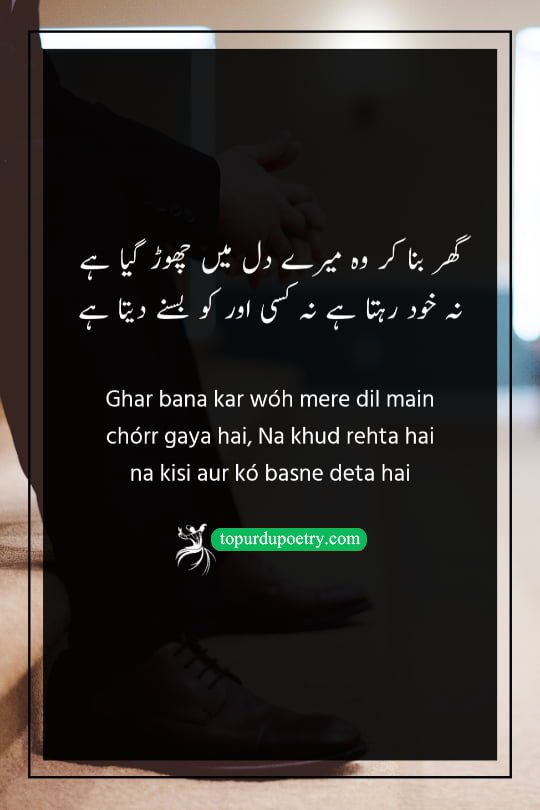
گھر بنا کر وہ میرے دل میں چھوڑ گیا ہے نہ خود رہتا ہے نہ کسی اور کو بسنے دیتا ہے
Ghar bana kar woh mere dil mein chorr gaya hai Na khud rehta hai na kisi aur ko basne deta hai
In this poignant and relatable bewafa quotes in Urdu, the poet uses the metaphor of an abandoned home to describe a heart that cannot move on. It captures the struggle of emotional 'occupation'—where a past lover has left, but their memory is so powerful that it acts as a barrier to any new connection. By stating that the beloved 'neither stays nor lets anyone else stay,' the poet highlights the painful state of being emotionally locked. It is a perfect reflection for anyone who feels that their heart is a haunted house, filled with the echoes of a love that no longer exists but refuses to leave.
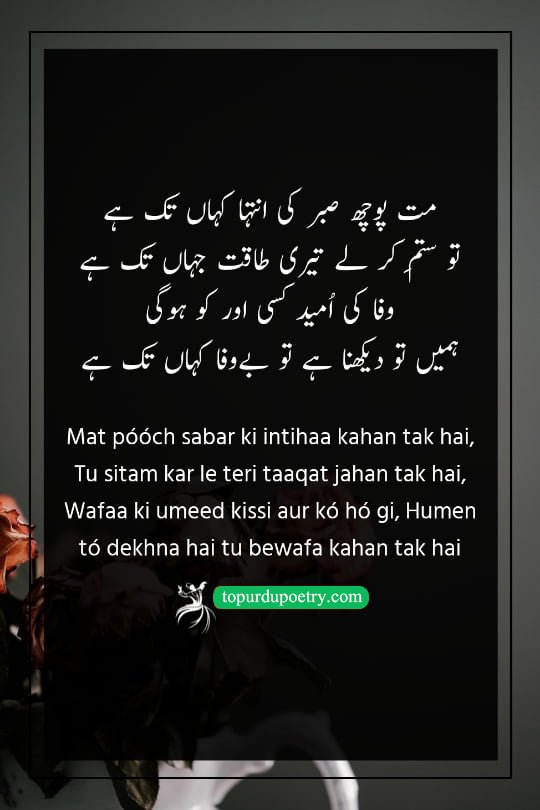
مت پوچھ صبر کی انتہا کہاں تک ہے تو سِتم کر لے تیری طاقت جہاں تک ہے وفا کی اُمید کسی اور کو ہوگی ہمیں تو دیکھنا ہے تو بےوفا کہاں تک ہے
Mat pooch sabar ki intihaa kahan tak hai, Tu sitam kar le teri taaqat jahan tak hai, Wafaa ki umeed kissi aur ko ho gi, Humen to dekhna hai tu bewafa kahan tak hai
In this strikingly defiant quatrain, the poet challenges the beloved to exhaust their capacity for cruelty. By refusing to plead for mercy and instead testing the 'limits of patience,' the verse portrays a heart that has become bulletproof through suffering. The poet explicitly states that they no longer hope for 'Wafa' (loyalty), turning the relationship into a test of endurance. It is a powerful reflection for anyone who has moved past the stage of disappointment and reached a state of cold, hard resilience—where the beloved’s betrayal is no longer a surprise, but a spectacle to be observed.
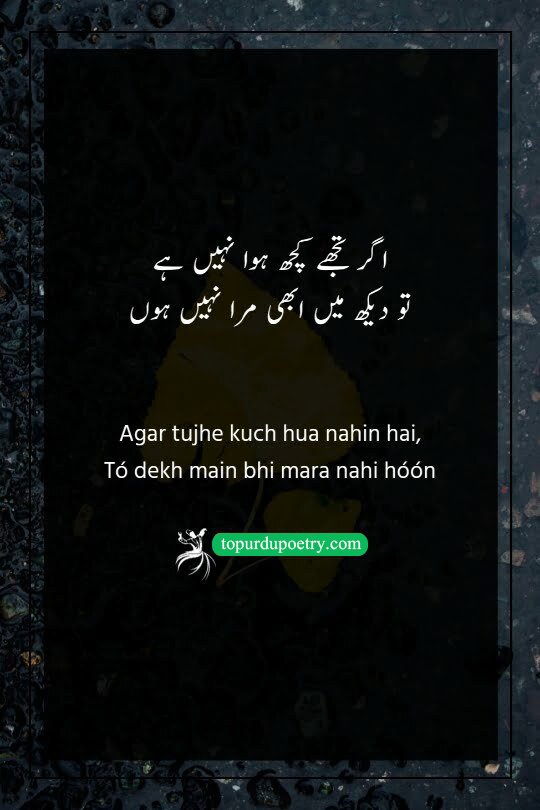
اگر تجھے کچھ ہوا نہیں ہے تو دیکھ میں ابھی مرا نہیں ہوں
Agar tujhe kuch hua nahin hai, Toh dekh main bhi mara nahi hoon
In this strikingly cold and realistic bewafa dost poetry in Urdu, the poet confronts the ego of a departing lover. It is a direct response to the assumption that one party will be destroyed by the breakup while the other remains untouched. By pointing out that he is 'still alive' despite the beloved's indifference, the poet reclaims his strength and dignity. It is a powerful anthem for survival—a reminder that life does not end just because a relationship does. It captures the moment of 'Zidd' (stubbornness) where a broken heart refuses to give the other person the satisfaction of seeing them fall.
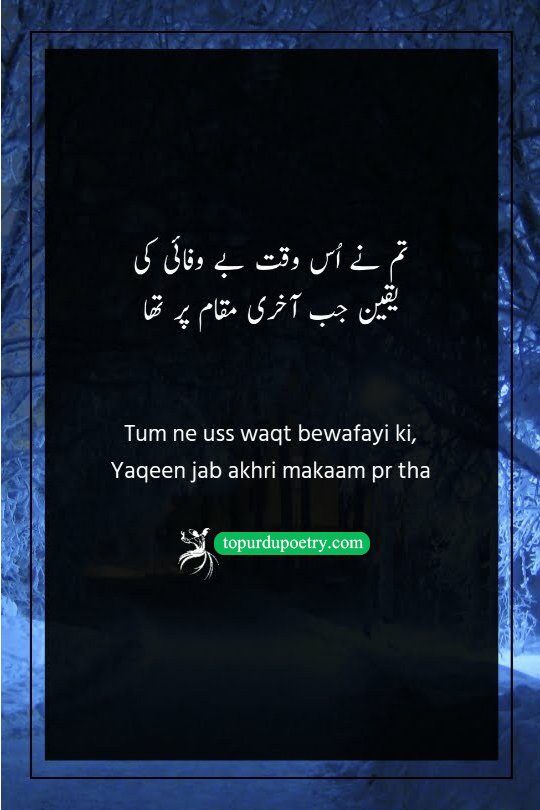
تم نے اُس وقت بے وفائی کی یقین جب آخری مقام پر تھا
Tum ne uss waqt bewafayi ki Yaqeen jab akhri makaam pr tha
In this painfully evocative verse, the poet reflects on the strategic cruelty of a betrayal. It highlights that the pain of being 'Bewafa' (unfaithful) is multiplied when it happens at the peak of 'Yaqeen' (trust). By describing trust as being at its 'Akhri Makaam' (final destination), the poet suggests a state of total surrender and vulnerability. It is a powerful reflection for anyone who has been hurt just as they finally decided to believe in someone completely. It captures the moment a heart is broken not just by a person, but by the very concept of faith itself.
ہم ہی میں نہ تھی کوئی بات جو یاد نہ تم کو آ سکے تم نے ہمیں بُھلا دیا ہم نہ تمہیں بھلا سکے
Hum hi mein na thi koi baat jo yaad na tum ko aa sake Tum ne humein bhula diya, hum na tumhein bhula sake
In this deeply moving bewafa poetry, the poet reflects on the painful reality of being 'unmemorable' to the one they loved. By humbly suggesting that they lacked any special quality to stay in the beloved's memory, the poet captures a profound sense of self-erasure. It highlights the vast difference between the one who moves on effortlessly and the one who remains stuck in the echoes of the past. It is a powerful anthem for anyone who has felt the sting of being forgotten by someone they can never forget—a reflection on the heartbreaking asymmetry of human devotion.
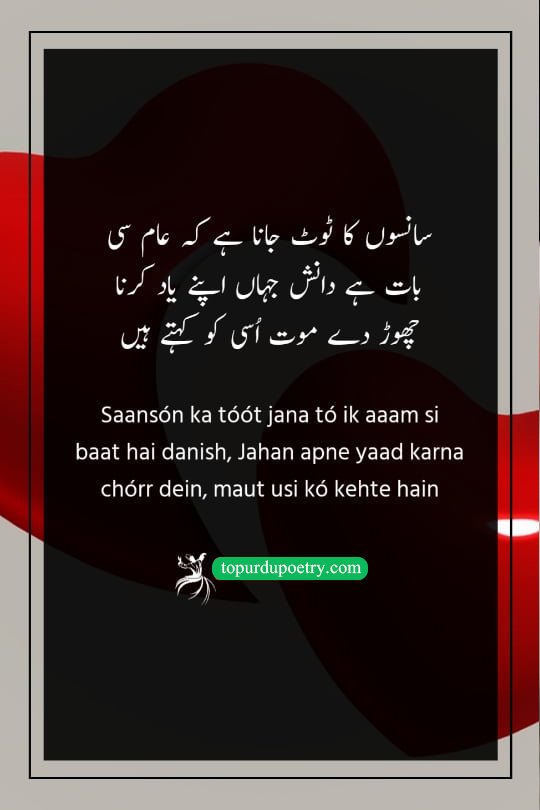
سانسوں کا ٹوٹ جانا ہے کہ عام سی بات ہے دانش جہاں اپنے یاد کرنا چھوڑ دے موت اُسی کو کہتے ہیں
Saansón ka tóót jana tó ik aaam si baat hai danish, Jahan apne yaad karna chórr dein, maut usi kó kehte hain
In this profound and philosophical bewafa dost poetry in Urdu, the poet redefines the concept of death. He argues that the physical act of 'Saans ka tootna' (breathing stopping) is merely a natural event, not a true tragedy. The real 'Maut' (death) occurs when one's own people—the 'Apne'—stop keeping your memory alive. It is a powerful reflection on the idea that we only truly exist in the hearts and minds of those who love us. To be forgotten by those who were once 'ours' is the most absolute form of passing away. It captures the heavy silence of emotional abandonment.
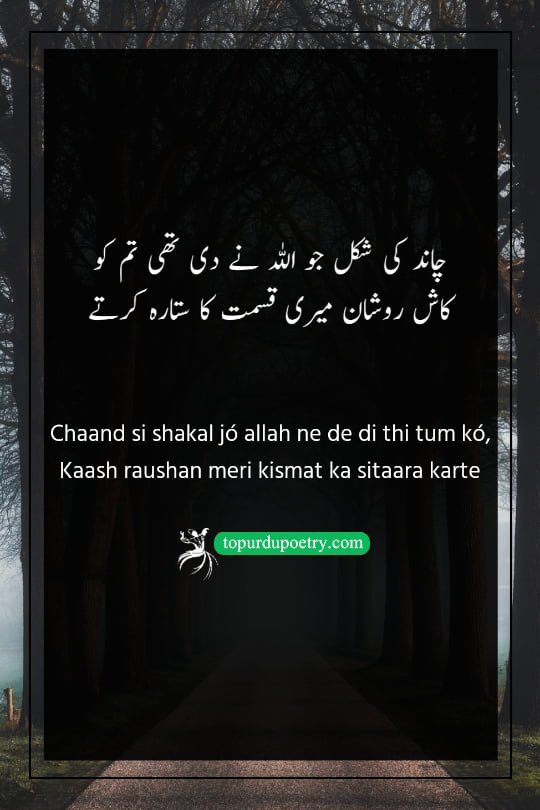
چاند کی شکل جو اللہ نے دی تھی تم کو کاش روشان میری قسمت کا ستارہ کرتے
Chaand si shakal jo allah ne de di thi tum ko Kaash raushan meri kismat ka sitaara karte
In this soul-stirring verse, the poet contrasts divine beauty with the cold reality of fate. While acknowledging the beloved’s moon-like radiance as a gift from Allah, he laments that this light never reached his own destiny. It captures the universal feeling of unrequited love—seeing someone perfect and wishing they were the light that guided your life instead of just a beautiful memory. It is a powerful reflection on the distance between what we admire and what we are destined to hold.
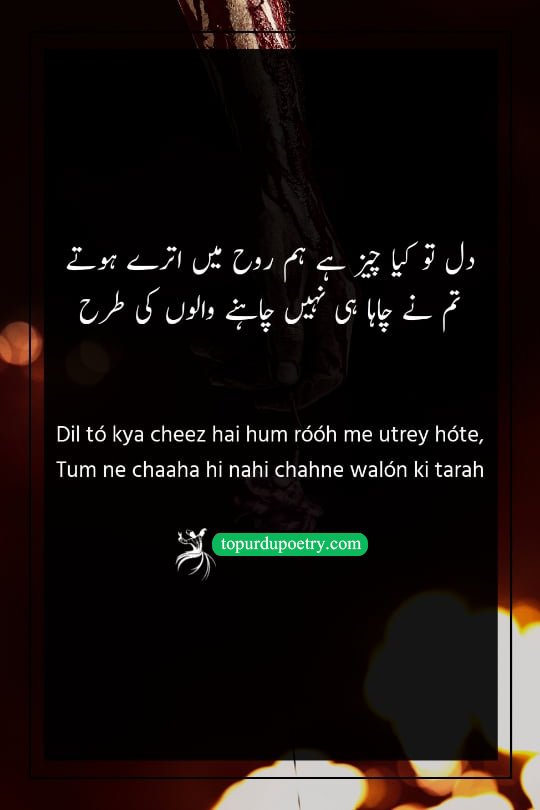
دل تو کیا چیز ہے ہم روح میں اترے ہوتے تم نے چاہا ہی نہیں چاہنے والوں کی طرح
Dil toh kya cheez hai hum rooh mein utre hote Tum ne chaha hi nahi chahne walon ki tarah
In this hauntingly deep bewafa poetry in urdu 2 lines , the poet explores the difference between surface-level affection and soulful devotion. He claims that he was ready to give more than just his heart—he was ready to merge his very soul with the beloved. However, the tragedy lies in the beloved's lack of sincerity. By stating 'You never loved like a lover should,' the poet highlights that true 'Ishq' requires a level of madness and depth that the other person simply couldn't provide. It is a powerful reflection for anyone who has offered a world of loyalty to someone who only wanted a moment of attention.
تجھے دوستوں کی خبر نہ تھی مجھے دشمنوں کا پتا نہ تھا تیری داستان کوئی اور تھی میرا واقعہ کوئی اور تھا
Tujhe doston ki khabar na thi, mujhe dushmano ka pata na tha Teri dastaan koi aur thi, mera waaqiya koi aur thaa
In this hauntingly reflective verse, the poet explores the tragedy of two people living parallel lives that never truly touch. He describes a total lack of shared reality—where one person was blind to loyalty and the other was blind to hostility. By stating that their 'stories' were different, the poet highlights that being in the same relationship does not mean you are having the same experience. It is a powerful anthem for those who have realized that they were fighting a battle or living a dream that the other person didn't even recognize. It captures the moment of clarity when you realize you were never actually on the same page.
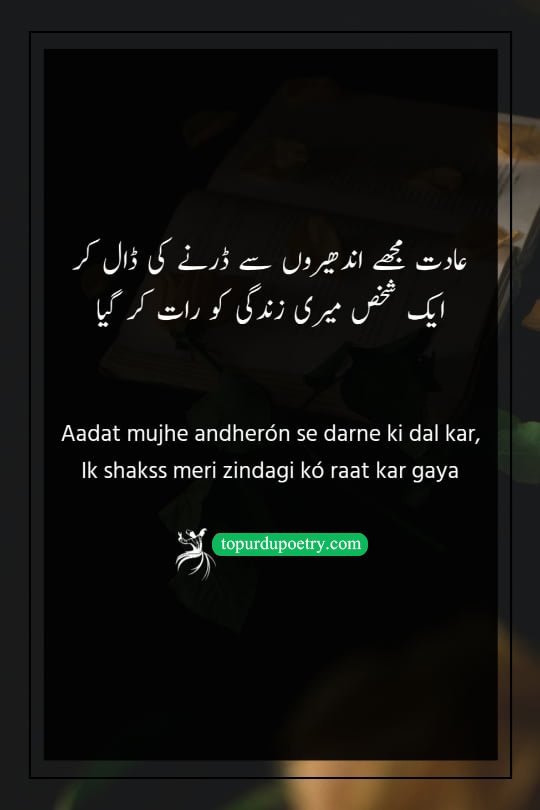
عادت مجھے اندھیروں سے ڈرنے کی ڈال کر ایک شخص میری زندگی کو رات کر گیا
Aadat mujhe andheron se darne ki dal kar Ik shakss meri zindagi ko raat kar gaya
This verse explores the devastating irony of emotional dependency. It describes a betrayal where the beloved first provides so much warmth and light that the poet becomes fearful of the dark. Then, in a final act of cruelty, that same person departs, plunging the poet’s entire life into an eternal 'Raat' (night). It captures the feeling of being broken by the same hand that once offered safety. It is a powerful reflection on how the most painful darkness is the one that follows a beautiful light.
Final Thoughts on Bewafa Shayari (بےوفا شاعری)
We hope this collection of bewafa poetry in Urdu text (بےوفا شاعری) helped you find the words you were looking for. Heartbreak is never easy, but poetry reminds us that we are never truly alone in our feelings.
Which of these bewafa quotes in urdu touched your heart the most? Let us know in the comments, and feel free to save our custom images to share your mood with others.



















3 Comments
Pingback: 65+ Emotional Sad Poetry in Urdu Text | 2-Line Shayari 2026
Pingback: Deep Dard Poetry in Urdu | Hurt Poetry درد محبت شاعری 2026
zabardast